Reviving Ancient Seeds: Sustainable Solutions for Climate Resilience
By The Living Soil Lab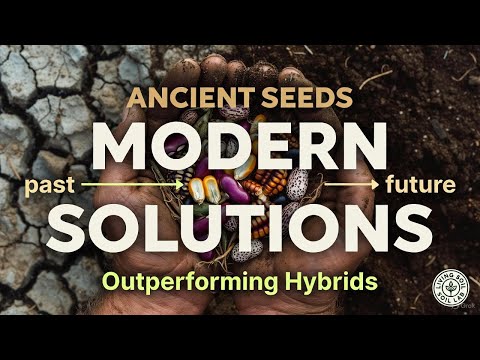
PermaNews Brief
Key Takeaways
Heritage crops and regenerative practices can effectively combat climate challenges.
- Ancient crops enhance drought tolerance and nutrient density.
- Regenerative practices are crucial for crop resilience.
- Smallholder farmers benefit from seed saving initiatives.
- Heritage varieties often outperform modern crops in stress conditions.
- Biodiversity is essential for long-term agricultural stability.
Why It Matters
Utilizing ancient seeds and regenerative practices empowers local farmers and enhances food security in unpredictable climates.
What to Do Next
Explore local seed saving initiatives and regenerative farming practices.
Permaculture Context
For permaculture designers and regenerative growers, this work confirms something that experienced practitioners have long suspected but rarely seen documented at scale: the most sophisticated breeding program on Earth already happened, across millennia of farmer-led selection under real-world stress conditions. What this means practically is that your seed sourcing decisions are now design decisions. Choosing heritage sorghum, landrace millet, or open-pollinated cowpea varieties from regionally adapted seed networks is not nostalgia — it is stacking functions at the genetic level before you even touch the soil. The critical nuance that often gets lost in mainstream coverage is that these varieties were developed within ecological systems, meaning they tend to express their full resilience potential only when paired with living soil and polyculture arrangements — exactly what regenerative systems provide. If you are building a homestead, community food garden, or farm-scale system, the actionable priority is twofold: locate a regional seed library or heritage seed network now, before a supply disruption forces the conversation, and invest in learning seed saving as a core skill rather than an optional extra. Genetic sovereignty and food sovereignty are ultimately the same thing.
Recommended for: Farmers and gardeners seeking sustainable solutions in changing climates.
This video documents the complete revival of resilient ancient crops, demonstrating how heritage seeds combined with regenerative soil practices deliver superior drought tolerance, pest resistance, and nutrient density. The central thesis is that agricultural solutions for climate chaos do not require corporate laboratories because centuries of adaptation have already created crops perfectly suited for these challenges. The content highlights specific examples from East Africa, where organizations like the Seed Savers Network support smallholder farmers cultivating heritage sorghum, millet, and cowpe varieties that consistently outperform modern alternatives during drought and stress events. The video argues that pairing regenerative practices—such as soil health restoration, composting, and biodiversity enhancement—with heritage crops amplifies their performance and resilience, creating a synergistic effect that modern monocultures cannot achieve. It emphasizes the return of control over food production to farmers and gardeners through seed saving, fostering self-sufficiency and reducing reliance on industrial supply chains. The narrative connects the genetic diversity of ancient seeds with the ecological stability required for long-term resilience, suggesting that heritage varieties possess a 'forgotten' toolkit of traits for surviving extreme weather. By showcasing real-world applications in East Africa, the video provides a practical case study for how heritage breeding can be integrated into regenerative living systems globally. The content serves as a powerful argument for the preservation and active breeding of heritage varieties as a primary strategy for climate adaptation, offering a roadmap for gardeners and farmers to build food systems that are robust against future environmental uncertainties.
Source: youtube.com
Related Analysis
- High-Salt Fertilizers Block Soil Microbes, Kempf Says — High-salt fertilizers disrupt soil microbes and microbial colonization, trapping farmers in chemical dependency. Biologi…
- Fertilizer Shortage Forces Reckoning on Nitrogen Sources — Fertilizer supply crisis drives farms toward nitrogen-fixing cover crops, compost, and legume rotations as alternatives.
Related on PermaNews
- Ernst Götsch's Cacao Syntropy: Master Agroforestry Now (How-To Guide)
- Designing Regenerative Resilience: Participatory Living Labs (How-To Guide)
- Lo—TEK: Indigenous Tech for Climate Solutions (Article)
- Nakivale's Regenerative Toilets: Refugee Resilience, Circular Sanitation (Case Study)
- Pippin Home Designs: Regenerative Home Design Explained (How-To Guide)
- Federal Policy Shift: Native Regenerative Ag for Soil & Carbon (Article)
Explore more in Food Systems & Growing — the full hub for this knowledge area.