Ernst Götsch's Cacao Syntropy: Master Agroforestry Now
PermaNews Brief
Key Takeaways
Learn to implement syntropic agroforestry with cacao, drawing on Ernst Götsch’s proven regenerative farming methods.
- Master high-density planting and successional sequencing for optimal growth.
- Utilize strategic pruning to stimulate plant and soil biological activity.
- Integrate cacao cultivation from seedling to commercial processing.
- Apply field-tested strategies for resilient tropical agroforests.
- Transition degraded land into productive, biodiverse ecosystems.
Why It Matters
Syntropic agroforestry, particularly with cacao, offers a powerful model for regenerating degraded landscapes while creating economically viable and sustainable food systems. This approach significantly enhances biodiversity and soil health.
What to Do Next
Explore the Forests4Farming Academy course to learn detailed system design and management protocols.
Permaculture Context
Für Praktikerinnen und Praktiker, die ernsthaft in die Permakultur oder regenerative Landwirtschaft einsteigen wollen, markiert dieses Kursangebot einen wichtigen Wendepunkt: Syntropische Agroforstwirtschaft war bislang weitgehend in Portugiesisch verfügbar oder durch teure Exkursionen nach Brasilien zugänglich – nun öffnet sich dieses Wissen einem breiteren Publikum. Was Ernst Götschs Ansatz von vielen anderen Agroforstsystemen unterscheidet, ist das tiefe Verständnis von Sukzession als aktivem Werkzeug, nicht nur als passivem Prozess. Wer einen degradierten Standort bewirtschaftet – sei es ein brachliegendes Feld in Mitteleuropa oder eine ausgelaugte Tropenplantagenfläche – findet hier eine strukturierte Methodik, die nicht auf Inputs angewiesen ist, sondern auf biologische Intelligenz setzt. Konkret bedeutet das: Wer lernt, Schnittinterventionen präzise zu timen und Pflanzengemeinschaften in Sukzessionsschichten zu denken, kann schneller produktive, stabile Systeme aufbauen, als es konventionelle Ansätze erlauben. Kakao ist dabei nicht zufällig gewählt – er ist ein Indikator für systemische Reife und wirtschaftliche Tragfähigkeit zugleich, was diesen Kurs besonders für jene relevant macht, die Selbstversorgung mit kommerziellem Potenzial verbinden mö
Recommended for: Experienced farmers and permaculture practitioners seeking advanced regenerative agroforestry techniques for tropical and subtropical environments.
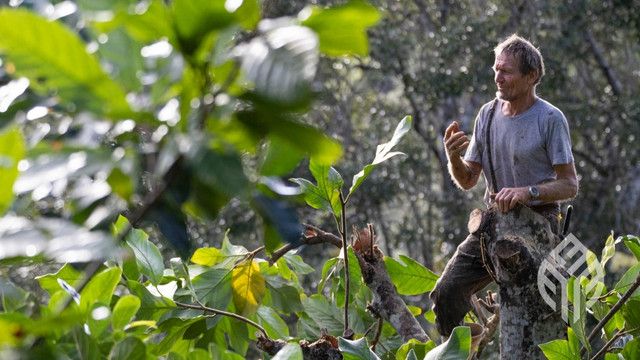
This comprehensive online course from Forests4Farming Academy teaches practitioners how to establish and manage syntropic agroforestry systems with cacao as the primary crop, drawing directly from Ernst Götsch’s over 40 years of hands-on experience in regenerative farming in Brazil. Participants learn detailed system design principles, including high plant density through succession planting—where species are strategically layered in temporal sequences to mimic natural forest regeneration—and stratification, organizing plants by light requirements for optimal photosynthesis and biomass production. Key practical methods covered include targeted pruning techniques to release growth impulses, similar to natural processes like a bear breaking branches, which stimulate new growth in plants, fungi, and microorganisms while keeping soil perpetually covered by living roots to optimize nutrient cycling and prevent erosion. The course provides step-by-step protocols for cacao cultivation, from initial site preparation and seedling integration to ongoing management, fermentation, and drying processes tailored for commercial viability. Field-tested strategies ensure resilience in tropical and sub-tropical climates, with emphasis on the farmer’s role as a co-creator within the ecosystem, accelerating succession for rapid yields. Learners gain actionable insights into tools for system monitoring, safety protocols for pruning and harvesting, and scaling from small plots to larger farms. Backed by Götsch’s proven results in transforming degraded lands into productive agroforests, the free course includes video tutorials, practical field strategies, and community support for global knowledge exchange. Ideal for permaculture designers integrating syntropic methods, it offers concrete, measurable outcomes like enhanced soil biology, increased biodiversity, and sustainable cacao production without synthetic inputs, making it a high-signal resource for regenerative agriculture practitioners seeking field-tested, Ernst Götsch-inspired techniques.
Source: academy.forests4farming.org
Related Analysis
- Water-Harvesting Swales: What They Cost, Where Practitioners Agree — and the One Real Safety Debate — Swales — level, on-contour ditches that slow, spread and sink rainwater into the soil — are a foundational permaculture …
- High-Salt Fertilizers Block Soil Microbes, Kempf Says — High-salt fertilizers disrupt soil microbes and microbial colonization, trapping farmers in chemical dependency. Biologi…
- Fertilizer Shortage Forces Reckoning on Nitrogen Sources — Fertilizer supply crisis drives farms toward nitrogen-fixing cover crops, compost, and legume rotations as alternatives.
Related on PermaNews
- Finnish Off-Grid: Rocket Mass Heater Performance in Greenhouse (Case Study)
- Designing Regenerative Resilience: Participatory Living Labs (How-To Guide)
- Berlins schwimmende Gärten: Permakultur auf dem Wasser (Case Study)
- Lo—TEK: Indigenous Tech for Climate Solutions (Article)
- Rodale Report 2025: Thermal Mass Boost in Solar Greenhouses (Case Study)
- Nakivale's Regenerative Toilets: Refugee Resilience, Circular Sanitation (Case Study)
Explore more in Food Systems & Growing — the full hub for this knowledge area.