Cole Gross: Soil Health's Carbon & Pasture Power
By Cornell SIPS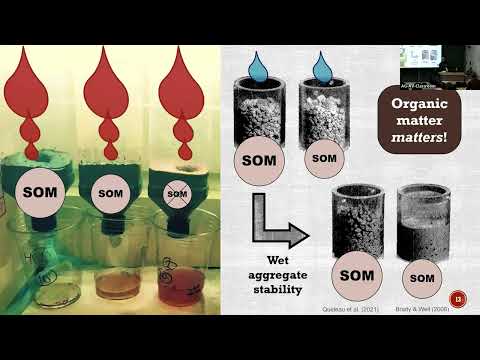
PermaNews Brief
Key Takeaways
Healthy soil is crucial for capturing carbon and sustainable farming, offering a powerful tool for climate change mitigation and food security.
- Boost soil organic carbon for climate goals.
- Minimize disturbance, maximize ground cover.
- Diverse plants enhance soil carbon storage.
- Regenerative agriculture restores degraded lands.
- Soil health links to global climate action.
Why It Matters
Improving soil health directly supports climate change mitigation through carbon sequestration and boosts food security by enhancing land productivity and resilience.
What to Do Next
Explore the "4 per 1000" initiative for soil carbon enhancement.
Recommended for: Farmers, researchers, and policymakers interested in advanced soil science and climate solutions.
In this seminar, Cole Gross from SUNY College of Environmental Science and Forestry explores the importance of soil health for carbon sequestration and sustainable farming. The talk delves into the challenges of increasing soil organic carbon (SOC) stocks, particularly in pasture management systems. It discusses how soil health underpins the ability of soils to trap carbon effectively, which is essential for regenerative agriculture practices that aim to restore degraded lands and improve ecosystem resilience. The seminar highlights scientific insights into soil biology, organic matter dynamics, and practical management techniques that can enhance carbon storage in soils. These include minimizing soil disturbance, maintaining ground cover, and integrating diverse plant species. The presentation aligns with broader climate action goals such as those promoted by the "4 per 1000" initiative, emphasizing that improving soil health is a key lever for climate mitigation and food security. The seminar, dated December 4, 2025, provides both theoretical background and applied knowledge for farmers, researchers, and policymakers interested in advancing soil-based climate solutions.
Source: youtube.com
Related Analysis
- High-Salt Fertilizers Block Soil Microbes, Kempf Says — High-salt fertilizers disrupt soil microbes and microbial colonization, trapping farmers in chemical dependency. Biologi…
- Fertilizer Shortage Forces Reckoning on Nitrogen Sources — Fertilizer supply crisis drives farms toward nitrogen-fixing cover crops, compost, and legume rotations as alternatives.
Related on PermaNews
- Ernst Götsch's Cacao Syntropy: Master Agroforestry Now (How-To Guide)
- Designing Regenerative Resilience: Participatory Living Labs (How-To Guide)
- Lo—TEK: Indigenous Tech for Climate Solutions (Article)
- Nakivale's Regenerative Toilets: Refugee Resilience, Circular Sanitation (Case Study)
- Pippin Home Designs: Regenerative Home Design Explained (How-To Guide)
- Federal Policy Shift: Native Regenerative Ag for Soil & Carbon (Article)
Explore more in Food Systems & Growing — the full hub for this knowledge area.