Can Straw Bale Buildings Help the Planet?
By David Arkin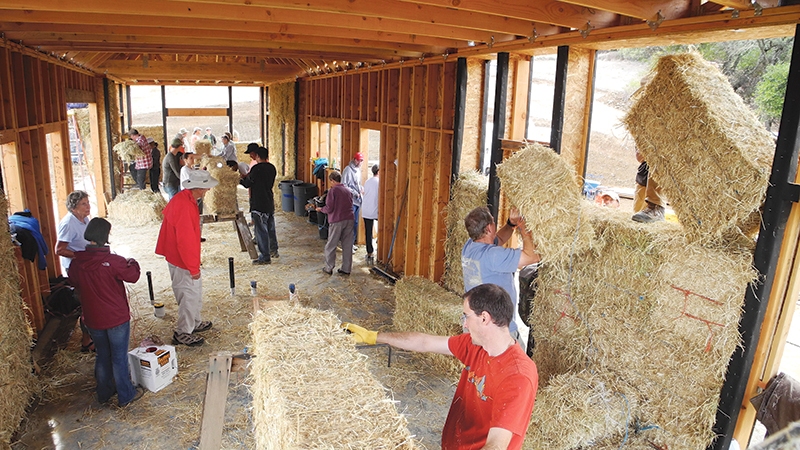
PermaNews Brief
Key Takeaways
Exploring straw bale construction reveals its ecological benefits and contextual relevance.
- Straw bales are locally sourced materials.
- Natural building adapts to local climates.
- Materials impact ecological fit and self-sufficiency.
- Broader ecosystem includes cob and hempcrete.
- Building methods should fit the environment.
Why It Matters
This perspective promotes sustainable construction practices that enhance resilience and ecological compatibility.
What to Do Next
Research local sourcing options for straw and other natural materials.
Permaculture Context
For permaculture designers and homesteaders, the real significance of straw bale's resurgence isn't the material itself — it's what it represents as a design philosophy made physical. When you choose a building system rooted in local abundance, you're not just reducing embodied carbon or cutting transport costs; you're practicing zone-zero permaculture, where the built environment becomes an extension of the same logic you apply to food systems, water harvesting, and soil health. Straw bale, cob, and hempcrete aren't interchangeable options on a green building menu — they're site-specific responses, and getting that distinction right has real consequences for thermal performance, moisture management, maintenance load, and long-term resilience. For someone designing toward genuine self-sufficiency, this framing reframes a building decision as a systems question: what does this landscape produce, what climate pressures will this structure face, and how do those two answers converge? That's the practitioner's actual entry point — not aesthetics, not trend, but material logic aligned with place. Buildings designed from that foundation tend to last, perform, and integrate rather than sit awkwardly on the land demanding external inputs indefinitely.
Recommended for: Readers interested in sustainable construction practices.
This article offers a useful, field-level overview of natural building and explains why straw bale construction is often discussed in regenerative and resilience-oriented building circles. It frames natural building as construction that is rooted in place, responsive to local climate, and made from resources that are indigenous or readily available without extensive processing. That definition matters because it connects material choice directly to ecological fit and supply-chain simplicity, which are central concerns in self-sufficiency planning. The piece also situates straw bale within a broader family of natural building materials, including earth-based systems such as adobe, clay plasters, rammed earth, cob, wattle and daub, and hempcrete, which helps readers compare straw bale to adjacent methods rather than treating it as an isolated niche technique. The practical value of the article is in its framing: it emphasizes the idea that building method should follow climate and place, not just aesthetics. For practitioners, that is a concrete decision-making lens when evaluating whether straw bale, cob, hemp-lime, or mixed systems are appropriate for a given site. The article is also relevant because it connects natural building to current climate and land-use conversations instead of presenting it as a purely alternative lifestyle topic. While it is not a step-by-step guide or a construction manual, it gives enough context to support material selection, early-stage concept development, and conversations with designers or builders. For readers exploring regenerative housing, it functions best as an orientation piece that explains the philosophy behind natural building and clarifies how straw bale fits into a broader ecosystem of low-processed, locally responsive construction approaches.
Source: oaklandmagazine.com
Related Analysis
- High-Salt Fertilizers Block Soil Microbes, Kempf Says — High-salt fertilizers disrupt soil microbes and microbial colonization, trapping farmers in chemical dependency. Biologi…
- Fertilizer Shortage Forces Reckoning on Nitrogen Sources — Fertilizer supply crisis drives farms toward nitrogen-fixing cover crops, compost, and legume rotations as alternatives.
Related on PermaNews
- Ernst Götsch's Cacao Syntropy: Master Agroforestry Now (How-To Guide)
- Designing Regenerative Resilience: Participatory Living Labs (How-To Guide)
- Lo—TEK: Indigenous Tech for Climate Solutions (Article)
- Nakivale's Regenerative Toilets: Refugee Resilience, Circular Sanitation (Case Study)
- Pippin Home Designs: Regenerative Home Design Explained (How-To Guide)
- Federal Policy Shift: Native Regenerative Ag for Soil & Carbon (Article)
Explore more in Shelter, Energy & Infrastructure — the full hub for this knowledge area.