Off-The-Grid Tiny House & Stunning Syntropic Food Forest Gardens
By Living Big In A Tiny House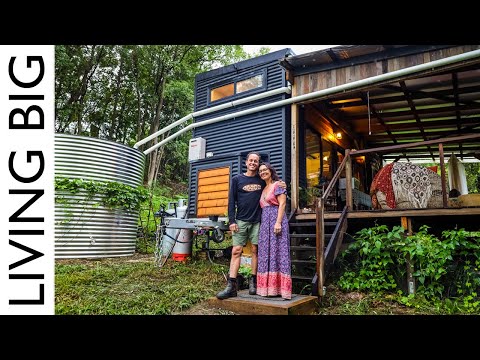
PermaNews Brief
Key Takeaways
An integrated tiny house and food forest showcases regenerative living principles.
- Off-grid tiny house optimizes small footprint
- Syntropic gardens enhance food production
- Ecological design integrates housing and gardening
- Supports microclimate and landscape regeneration
- Practical for resilient, self-sufficient living
Why It Matters
This project emphasizes the relationship between housing and productive ecology, showcasing how compact living can contribute to land stewardship and sustainability.
What to Do Next
Watch the video to explore practical off-grid living approaches.
Permaculture Context
What this property demonstrates is something that permaculture design courses often struggle to convey in the classroom: the compounding relationship between reduced built infrastructure and expanded ecological productivity. When a household commits to a small dwelling footprint, the freed land area does not simply sit idle — it becomes available for the layered, time-sensitive work of syntropic succession planting, where each planted zone actively supports the next. Practitioners should pay close attention to this dynamic because it reframes the tiny house not as an aesthetic or financial choice but as a land-use decision with direct consequences for food resilience and soil carbon. In New South Wales, where seasonal drought pressure and fire risk are genuine design constraints, a well-established food forest canopy also functions as a microclimate buffer for the dwelling itself, reducing cooling loads and improving air quality. For anyone in the planning stages of a similar project, the practical implication is sequencing: get the perennial planting structure established early, design the house placement around the garden's sun and wind logic, and treat shelter and ecology as a single integrated system from the outset.
Recommended for: Individuals interested in practical examples of regenerative living.
This video documents an off-grid tiny house situated within a syntropic and regenerative food forest environment, making it highly relevant to readers interested in low-impact housing as part of a broader land-use system. The content appears to be a field visit rather than a conceptual overview, which increases its usefulness for practitioners because it shows how the house, the landscape, and the food production system coexist in practice. The strongest signal here is the combination of mobile or compact housing with an actively managed regenerative planting system.
The value of the video is in its likely on-site visual evidence. Viewers can observe how a tiny house on wheels is embedded in the landscape, how the surrounding garden has been structured, and how the regenerative principles are expressed spatially. That is important for people studying resilience-oriented housing because many articles discuss tiny homes in isolation, while this item appears to show the dwelling as part of a functioning ecological setting. The result is more useful for understanding the lived realities of off-grid domestic life, land productivity, and design integration.
The snippet indicates that the property is in New South Wales and highlights both the tiny house and the food forest gardens. For someone researching self-sufficiency, the key practical takeaway is the relationship between shelter and productive ecology: compact housing reduces built footprint, while syntropic planting can support food production, microclimate improvement, and landscape regeneration. The video is therefore more than a lifestyle showcase; it can help viewers see how housing decisions affect land stewardship outcomes.
Because this is a video rather than a written case report, it likely offers fewer technical specifications than a formal build guide. Even so, it still qualifies as a substantive reference for regenerative tiny-house design because it captures an implemented project in situ. For anyone comparing off-grid dwellings, permaculture homesteads, or small-footprint housing models, it provides concrete visual evidence of how those systems can be combined.
Source: youtube.com
Related Analysis
- Off-Grid Homesteads Merge Thermal and Electrical Renewable Systems — Several 2024–2025 case studies show off-grid permaculture sites pairing rocket mass heaters with solar or micro-hydro el…
- Off-Grid Solar Projects Shed Legacy Batteries for LFP — Several sources suggest LFP batteries are becoming the go-to storage solution as solar adoption grows across off-grid an…
Related on PermaNews
- Ernst Götsch's Cacao Syntropy: Master Agroforestry Now (How-To Guide)
- Finnish Off-Grid: Rocket Mass Heater Performance in Greenhouse (Case Study)
- Berlins schwimmende Gärten: Permakultur auf dem Wasser (Case Study)
- Rodale Report 2025: Thermal Mass Boost in Solar Greenhouses (Case Study)
- AUTarcaMatricultura La Palma: Permakultur & Energieautarkie (How-To Guide)
- Earthaven Ecovillage: 30 Years Off-Grid with Hydro & Solar (Video)
Explore more in Shelter, Energy & Infrastructure — the full hub for this knowledge area.