Chad's Sahel: Watershed Rain Capture Fights Desertification
By Andrew Millison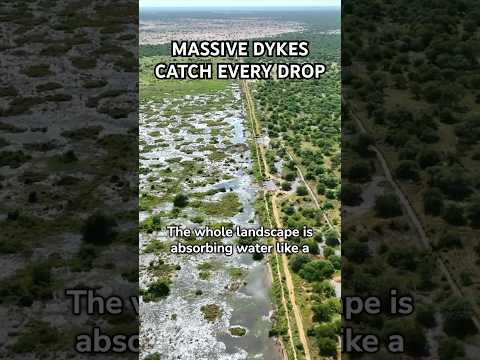
PermaNews Brief
Key Takeaways
Large-scale rainwater harvesting in Chad combats desertification by capturing and retaining water across entire landscapes, improving livelihoods and restoring degraded land.
- Watershed-scale approach maximizes water infiltration and groundwater recharge.
- Earthworks like contour bunds and check dams slow and spread water.
- Tree planting with native species restores degraded land and boosts biodiversity.
- Community involvement is crucial for successful and sustainable projects.
Why It Matters
This initiative demonstrates effective strategies for arid regions to combat desertification, enhance water security, and improve agricultural productivity, offering a replicable model for climate change adaptation.
What to Do Next
Explore how watershed-scale rainwater harvesting principles could apply to your local environment by observing natural water flow.
Recommended for: Land managers, community leaders, and permaculture enthusiasts in arid and semi-arid regions interested in large-scale water management and ecological restoration.
In the Sahel region of Chad, a significant initiative is underway to implement watershed-scale rainwater harvesting, a crucial strategy for combating desertification and improving livelihoods in an arid environment. This project focuses on a series of interventions designed to capture and retain rainfall across entire landscapes, rather than just individual farms or households. The core principle behind this approach is to slow down, spread out, and sink the water, maximizing its infiltration into the soil and recharging groundwater reserves.
The primary techniques employed involve the construction of various earthworks. These include contour bunds, which are earthen banks built along the contours of the land to impede water flow and encourage infiltration. These bunds are often combined with small, crescent-shaped structures or "demi-lunes" that further enhance water retention in specific areas, particularly around newly planted trees or crops. Another key element is the creation of check dams or gabion structures in ephemeral streambeds and wadis. These structures slow down flash floods, allowing water to spread out and soak into the surrounding land, preventing erosion and promoting sediment deposition.
The project also emphasizes the restoration of degraded land through tree planting. By capturing more water, the soil moisture content increases, creating more favorable conditions for vegetation growth. Native, drought-resistant tree species are prioritized, as they are well-adapted to the local climate and contribute to biodiversity. The re-establishment of tree cover provides multiple benefits, including shade, windbreaks, improved soil fertility through leaf litter, and habitat for wildlife. Over time, this can lead to a positive feedback loop where increased vegetation further enhances water infiltration and soil health.
A critical aspect of this watershed-scale approach is community involvement and local knowledge integration. The success of these interventions relies heavily on the participation of local communities in the planning, construction, and maintenance of the earthworks. Traditional ecological knowledge regarding water management and land use is often incorporated into the design and implementation phases. This not only ensures the sustainability of the project but also empowers local populations to take ownership of their environment and adapt the strategies to their specific needs and conditions. Training programs are often conducted to equip community members with the necessary skills for building and maintaining the structures.
The long-term goals of these rainwater harvesting projects extend beyond immediate water availability. By restoring ecological balance and improving soil health, they aim to enhance agricultural productivity and food security. Increased groundwater levels can support perennial vegetation and provide more reliable water sources for both human consumption and livestock. The reduction in soil erosion protects valuable topsoil, preventing further land degradation. Ultimately, these initiatives contribute to building resilience against climate change impacts, such as prolonged droughts and unpredictable rainfall patterns, offering a sustainable pathway for communities in arid regions to thrive.
Source: youtube.com
Related Analysis
- Designers Push Urban Standard From Sustainable to Regenerative — Early signals point to a push for urban design that actively restores ecosystems, not merely reduces harm — with field-t…
- Scrapped EV Batteries Convert to Solar Storage in Off-Grid Markets — Several sources suggest retired EV batteries are finding a second role in rural off-grid solar systems, potentially lowe…
Related on PermaNews
- Dryland Permaculture: 50,000L Roof Harvest Cuts Water 70% in QLD (Case Study)
- Unwanted Water? We're Harvesting It! (Video)
- Build a 5,000-20,000L Ferrocement Cistern: Local Materials Guide (How-To Guide)
- Half-Moon Method: Desert to Farmland Transformation (Article)
- Rainwater Cisterns: Design, Build, & Install Guide (How-To Guide)
- Ontario RWH Systems: Performance & Urban Water Strategy (Case Study)
Explore more in Water, Climate & Adaptation — the full hub for this knowledge area.