After 7 Years in Tiny Houses, They Built Their Dream Earth Home
By Living Big In A Tiny House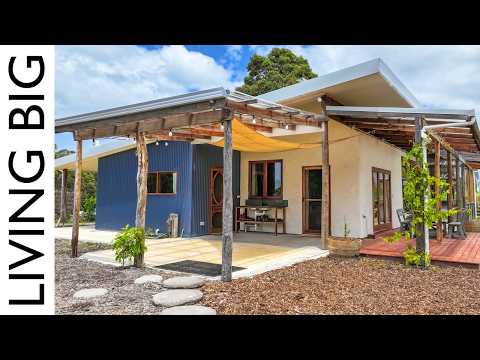
PermaNews Brief
Key Takeaways
A couple transitions from tiny house living to building a regenerative earth home in Western Australia.
- Designed for local wet climate
- Utilizes straw bale and cob construction
- Incorporates passive solar performance
- Features salvaged industrial windows
- Maintains tiny house philosophy
Why It Matters
This case study illustrates how alternative building methods can enhance sustainability and resilience in housing.
What to Do Next
Consider watching the video for thorough insights.
Permaculture Context
Brenna and Charlie's project matters to the permaculture community not simply because it's a beautiful build, but because it represents a maturing of the natural building movement — one where practitioners are moving beyond proof-of-concept experiments into deeply site-specific, climate-responsive permanence. For years, the conversation around natural building has suffered from a false binary: either you live lightly in a temporary structure, or you commit to a conventional home and compromise your values. This project dismantles that dichotomy. The integration of straw bale, cob, and light earth isn't aesthetic eclecticism — it's a sophisticated response to the distinct challenges of a wet temperate climate, where moisture management and thermal performance often pull in opposite directions. For practitioners actively designing their own homesteads, the practical takeaway is this: your building system should be chosen to solve your specific site problems, not borrowed wholesale from a tradition developed in a different bioregion. Sourcing clay on-site, salvaging industrial windows, and attaching a greenhouse as a thermal buffer are all decisions that reduce embodied energy while deepening your relationship to place — which is, ultimately, what regenerative living actually demands.
Recommended for: Individuals interested in sustainable living and regenerative practices.
This comprehensive case study documents the journey of Brenna and Charlie, a couple from Western Australia who transitioned from seven years of living in tiny houses to constructing a permanent, regenerative earth home that embodies permaculture principles while retaining the core philosophy of tiny living. Their new dwelling is a sophisticated integration of straw bale and cob construction, designed specifically to respond to their local wet climate and maximize passive solar performance. The house features walls constructed entirely of straw bale, which provides superior insulation, and a central east-west wall made of cob—a mixture of clay, sand, and straw—to add necessary thermal mass for temperature regulation. The design includes a third, rare technique called light earth, further enhancing the home's ecological footprint. Key architectural elements include passive solar orientation, where the sun enters at the optimal angle in winter while eaves and outdoor shading prevent overheating in summer. The home utilizes clay harvested directly from their own land, salvaged industrial windows that define the front facade, and an attached greenhouse that helps regulate internal temperatures throughout the seasons. The couple emphasizes that despite the move to a larger, permanent structure, they have not abandoned the tiny house philosophy; the passive solar design, simplicity, and deep connection to the land remain central to their lifestyle. This project demonstrates a practical application of regenerative housing that goes beyond minimalism to actively support soil health and biodiversity through the use of natural, locally sourced materials. The narrative highlights the importance of thermal mass, using heavy materials like water and clay slabs to stabilize indoor temperatures, and showcases how alternative building methods can create durable, self-sufficient homes that harmonize with their environment. The case study serves as a model for individuals seeking to implement low-impact, regenerative living strategies that prioritize environmental stewardship and community resilience.
Source: youtube.com
Related Analysis
- High-Salt Fertilizers Block Soil Microbes, Kempf Says — High-salt fertilizers disrupt soil microbes and microbial colonization, trapping farmers in chemical dependency. Biologi…
- Fertilizer Shortage Forces Reckoning on Nitrogen Sources — Fertilizer supply crisis drives farms toward nitrogen-fixing cover crops, compost, and legume rotations as alternatives.
Related on PermaNews
- Ernst Götsch's Cacao Syntropy: Master Agroforestry Now (How-To Guide)
- Finnish Off-Grid: Rocket Mass Heater Performance in Greenhouse (Case Study)
- Designing Regenerative Resilience: Participatory Living Labs (How-To Guide)
- Berlins schwimmende Gärten: Permakultur auf dem Wasser (Case Study)
- Lo—TEK: Indigenous Tech for Climate Solutions (Article)
- Rodale Report 2025: Thermal Mass Boost in Solar Greenhouses (Case Study)
Explore more in Shelter, Energy & Infrastructure — the full hub for this knowledge area.