Zinde Academy: Permaculture Training for Ecological Design
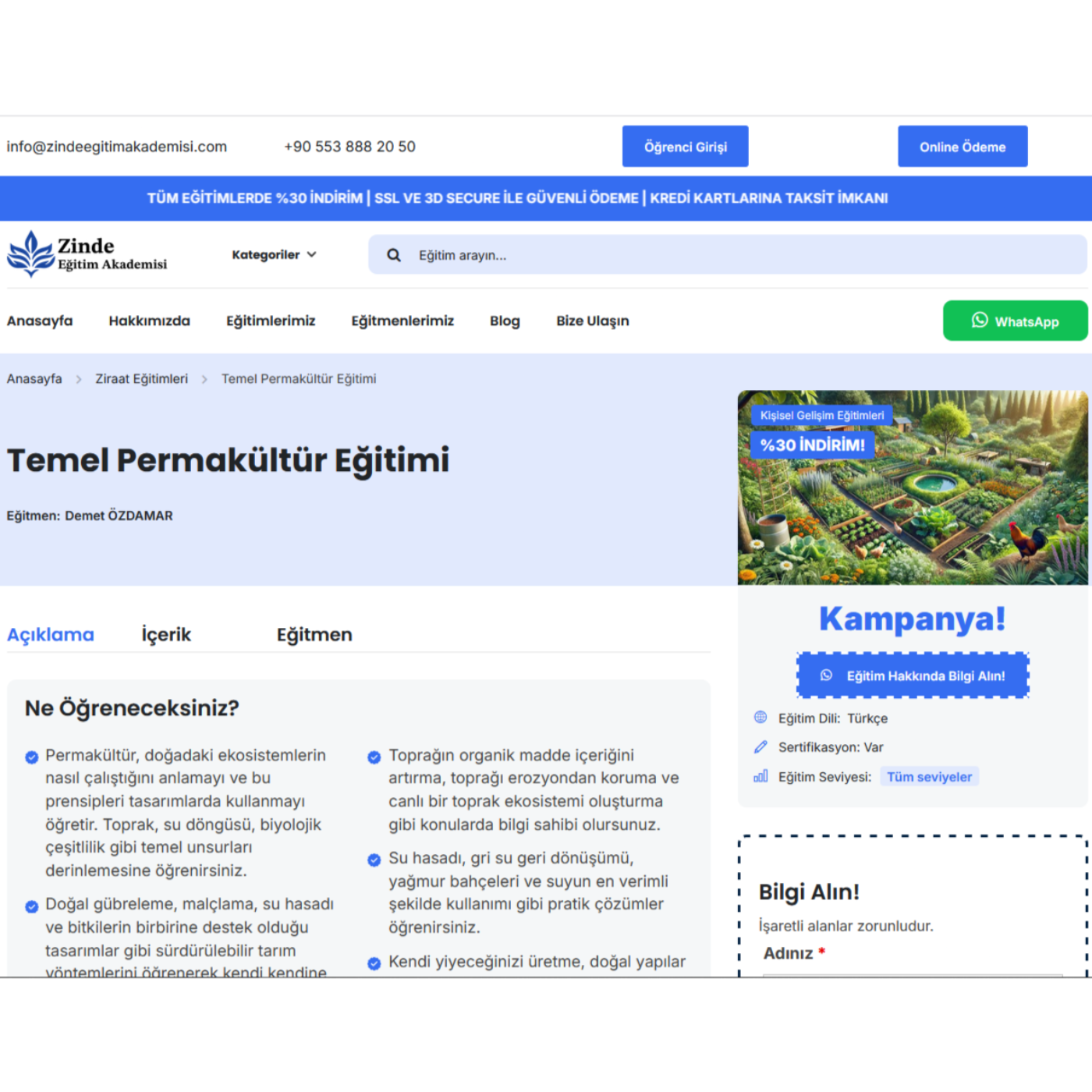
TL;DR: The Zinde Education Academy offers foundational permaculture training covering core principles, ethics, and ecological concepts for sustainable design.
- Learn permaculture principles and ethics for responsible application.
- Understand ecological concepts like nutrient cycling and soil health.
- Apply permaculture design in urban gardens to agricultural landscapes.
- Develop skills for resilient and productive systems.
- Explore practical examples for various permaculture contexts.
Why it matters: Understanding permaculture principles allows for the creation of sustainable and regenerative systems, crucial for addressing environmental challenges and promoting self-sufficiency.
Do this next: Explore the Zinde Education Academy website for permaculture training program details and registration.
Recommended for: Beginners and those seeking a holistic understanding of permaculture principles and their practical applications in diverse contexts.
The Zinde Education Academy is offering a foundational permaculture training program, designed to equip participants with a comprehensive understanding of permaculture principles and their practical applications. This program is part of the academy's broader mission to provide enriching and impactful content in both personal development and professional training sectors.
The curriculum for this permaculture training is structured to cover a wide array of topics, beginning with an introduction to permaculture itself. This initial phase delves into the core definitions, historical context, and the overarching philosophy that underpins permaculture design. Participants will learn about the ethical framework that guides permaculture, emphasizing care for the Earth, care for people, and fair share. Understanding these ethics is crucial for applying permaculture principles responsibly and sustainably.
A significant portion of the training focuses on the fundamental principles of permaculture design. This includes exploring how to observe and interact with natural systems, catch and store energy, obtain a yield, apply self-regulation and accept feedback, use and value renewable resources and services, produce no waste, design from patterns to details, integrate rather than segregate, use small and slow solutions, use and value diversity, use edges and value the marginal, and creatively use and respond to change. Each principle is examined in detail, with practical examples illustrating its relevance in various contexts, from urban gardens to larger agricultural landscapes.
The program also dedicates time to understanding ecological concepts that are integral to permaculture. This involves learning about ecosystems, biodiversity, nutrient cycling, water management, and soil health. Participants will gain insights into how these ecological processes function and how permaculture design can work in harmony with them to create resilient and productive systems. Special attention is given to soil regeneration techniques, composting, and the importance of healthy soil for overall ecosystem well-being.
Water management is another critical component of the training. This section covers various strategies for conserving, harvesting, and utilizing water efficiently. Topics include rainwater harvesting, greywater systems, swales, and pond construction, all aimed at creating water-wise landscapes that are less reliant on external water sources.
Plant systems and their role in permaculture design are extensively covered. This includes discussions on plant guilds, companion planting, food forests, and the selection of appropriate plant species for different climates and purposes. The training emphasizes the importance of perennial systems and native plants in creating stable and productive ecosystems.
Beyond the theoretical aspects, the training program aims to provide practical insights into implementing permaculture designs. This includes site analysis techniques, mapping, and the development of design strategies tailored to specific environments and goals. Participants will learn how to assess a site's unique characteristics, identify opportunities and constraints, and translate permaculture principles into actionable design plans.
The Zinde Education Academy emphasizes that this foundational permaculture training is suitable for a diverse audience, including individuals interested in sustainable living, gardeners, farmers, landscape designers, and anyone looking to deepen their understanding of ecological design. The program is structured to be accessible to those with varying levels of prior knowledge, providing a solid foundation for further exploration and application of permaculture concepts. The academy's commitment to delivering rich and effective educational content ensures that participants will emerge from the training with valuable knowledge and practical skills to contribute to more sustainable and regenerative futures.
Source: rss.com
Related Analysis
- Stacking Functions Emerges as Key to Resilience Practices — Emerging evidence shows stacking functions enhances community resilience through interlinked systems focused on efficien…
- Homesteading Moves Beyond Skill Acquisition to Durability — Homesteading is evolving beyond initial skill acquisition, with practitioners increasingly prioritizing long-term mainte…
Related on PermaNews
- Master David Holmgren's 12 Permaculture Principles (How-To Guide)
- Darren Doherty's Farm Planning Masterclass: Holistic Land Design (Video)
- Permaculture Visions: Online Training Pioneers Since 1993 (Event)
- Permakultur im Bündnerland: ProSpecieRara Praxisreihe 2026 (How-To Guide)
- Permaculture Explained: Sustainable Living Principles (Article)
- Permaculture Designer Tool: Open-Source Project for Eco-Design (How-To Guide)
Explore more in Skills, Preparedness & Self-Reliance — the full hub for this knowledge area.