Holmgren's RetroSuburbia: Permaculture for Resilient Living
By David Holmgren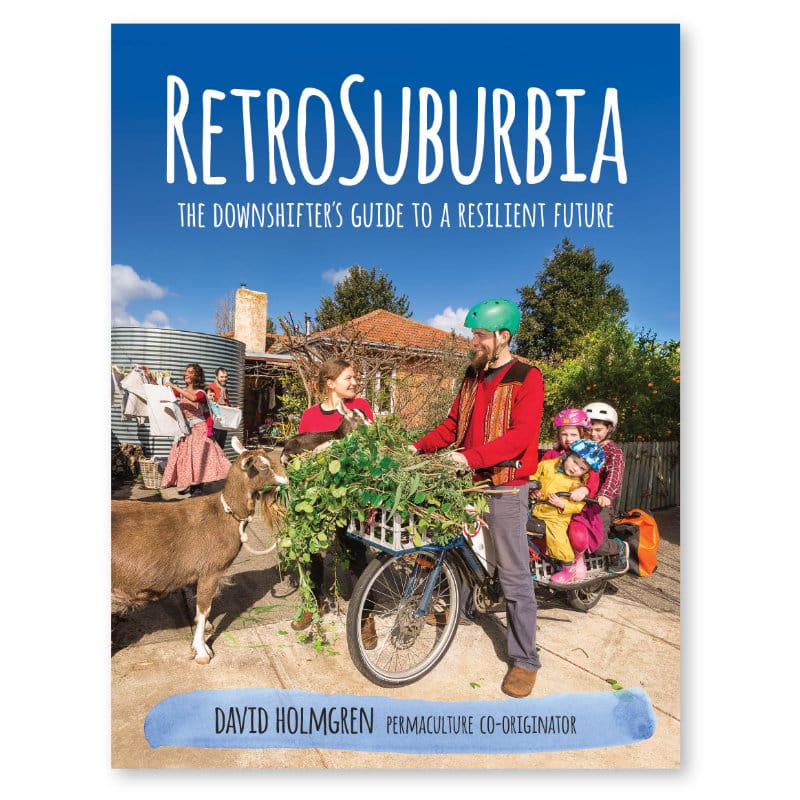
TL;DR: David Holmgren
- Transforming suburbs using permaculture for climate and economic resilience.
- Implement household and neighborhood self-reliance strategies.
- Embrace "Do-It-Ourselves" for community cooperation and local resilience.
- Apply permaculture ethics to retrofit homes, gardens, and lifestyles.
- Conserve resources and regenerate nature through integrated designs.
Why it matters: RetroSuburbia offers practical solutions for individuals and communities to increase self-reliance and resilience in the face of climate and economic instability. It provides a blueprint for transforming suburban living into a more sustainable and connected way of life.
Do this next: Identify one area in your home or garden where you can apply a permaculture principle for retrofitting and start planning its implementation.
Recommended for: Suburban homeowners, permaculture practitioners, and community organizers looking for actionable strategies to build resilience.
David Holmgren's RetroSuburbia, informed by permaculture ethics (earth care, people care, fair share) and principles, addresses climate and economic challenges with strategies for transforming suburbs. Part manual and manifesto, it offers real examples of retrofitting homes, gardens, and lifestyles for self-reliance and resilience at household and neighborhood levels. Holmgren, co-founder with Bill Mollison, demonstrates permaculture at Melliodora, his one-acre property in Hepburn, Victoria, developed since the mid-1980s. The book promotes 'Do-It-Ourselves' (DIO) over DIY, emphasizing community cooperation for suburban resilience. Practical content helps plan retrofitting with permaculture tools, responding to uncertainties through household actions. It builds on Holmgren's works like Principles and Pathways Beyond Sustainability, showcasing lived examples of sustainable alternatives to consumerism. Key insights include using permaculture for low ecological footprint living, connected to place and seasons, conserving resources, and regenerating nature. The text details suburb transformation via integrated designs, fostering neighborhood connections essential for thriving in energy descent. Practitioners gain concrete methods for applying ethics and principles in daily life, with case studies from Holmgren's projects illustrating scalable solutions from personal to community scales.
Source: permacultureeducationinstitute.org
Related Analysis
- Homeowners Retrofit Properties with Renewable Energy Solutions — Renewable energy retrofitting gains traction as regenerative agriculture principles inform home upgrades. Experts point …
- New Practices Build Climate-Resilient Cob Homes — Cob construction emerges as a key strategy in enhancing resilience against ecological challenges in permaculture systems…
Related on PermaNews
- Ernst Götsch's Cacao Syntropy: Master Agroforestry Now (How-To Guide)
- Finnish Off-Grid: Rocket Mass Heater Performance in Greenhouse (Case Study)
- Berlins schwimmende Gärten: Permakultur auf dem Wasser (Case Study)
- Autarke Permakultur-Siedlung: Solar-Wind & Redox-Flow-Speicher (Case Study)
- Rodale Report 2025: Thermal Mass Boost in Solar Greenhouses (Case Study)
- AUTarcaMatricultura La Palma: Permakultur & Energieautarkie (How-To Guide)
Explore more in Shelter, Energy & Infrastructure — the full hub for this knowledge area.