Strengthening India's Climate-Health Resilience: A Public Imperative
PermaNews Brief
Key Takeaways
India's climate resilience must align public health with sustainable development.
- Localized climate-smart adaptation is crucial.
- Invest in modern weather forecasting systems.
- Promote crop diversity and climate-linked insurance.
- Integrate health policies with climate resilience.
- Enhance infrastructure for flood and disaster management.
Why It Matters
Strengthening climate resilience in India is vital for protecting public health and livelihoods, especially in rapidly changing environmental conditions.
What to Do Next
Advocate for local climate adaptation initiatives in your community.
Permaculture Context
For permaculture designers and regenerative practitioners working across India's extraordinarily diverse bioregions, this policy framing represents something genuinely significant: institutional language is finally catching up to what practitioners have been demonstrating at village and farm scale for decades. The explicit endorsement of millets, micro-drip irrigation, and ecosystem-based coastal protection within a national resilience framework creates real leverage — funding pathways, policy alignment, and community credibility that grassroots projects have historically lacked. Practically, this means if you are establishing a food forest in a semi-arid watershed, designing a community seed bank, or restoring mangrove buffers along a coastal margin, you now have stronger grounds to connect your work to district-level planning processes and climate finance instruments. The deeper implication, though, is about design philosophy: genuine resilience cannot be engineered top-down through dashboards and advisories alone. It requires the kind of embedded, place-specific knowledge that permaculture practitioners carry. The opportunity here is to actively position regenerative land stewardship not as an alternative lifestyle choice, but as critical public infrastructure — because that is precisely what it is.
Recommended for: Policy makers, community leaders, and climate advocates.
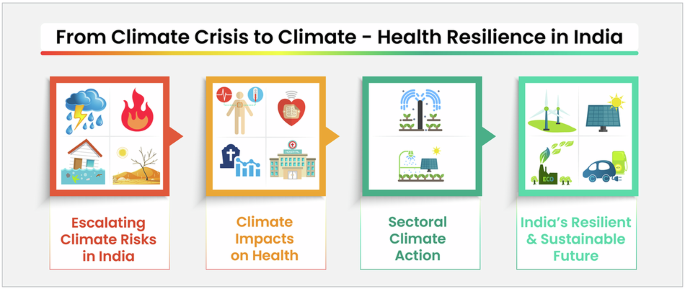
This Nature article argues that climate resilience in India is no longer a narrow environmental goal but a public-health and development imperative. It frames resilience as a systems challenge that cuts across agriculture, water, urban development, energy, infrastructure, and health. The article highlights that climate-smart adaptation must be localized and sector-specific, because different regions face different combinations of heat stress, flooding, water scarcity, and ecological degradation. A major practical theme is the need for modernized weather forecasting and early-warning systems, including mobile-based heatwave and flood advisories. In agriculture, the article recommends concrete measures such as crop diversification, especially millets promotion, climate-linked insurance, flexible subsidies, and solar irrigation paired with micro-drip systems. These are presented not as abstract goals but as tools to protect livelihoods while sustaining productivity under changing climate conditions. The article also emphasizes ecosystem-based adaptation, including mangrove restoration for coastal protection and stronger safeguards for Himalayan glaciers, river basins, and glacial lakes. It calls for eco-sensitive zoning, construction restrictions near vulnerable glacial areas, and GLOF risk mapping to reduce disaster risk. In flood management, it points to AI-based forecasting, district-level disaster dashboards, and stormwater infrastructure upgrades. Another important dimension is health-system resilience: the article argues that climate resilience must be mainstreamed into public health policy, backed by stronger intersectoral governance, more funding, resilient infrastructure, and grassroots capacity-building. The overall message is that India’s adaptation agenda should integrate renewable energy, ecosystem restoration, livelihood protection, and disaster preparedness into one coordinated development strategy rather than treating them as separate policy tracks. For practitioners, the article is useful because it translates climate resilience into operational priorities across sectors and identifies specific implementation levers that governments can scale through public investment and institutional coordination.
Source: nature.com
Related Analysis
- Practitioners Pivot From Water Restriction to Soil-Cycle Design — Early signals suggest regenerative gardeners are shifting from water-restriction rules to system-level design — using so…
- California Homesteaders Retrofit Greywater Before Drought Season — Several sources suggest CA homesteaders are retrofitting greywater systems ahead of drought season, prioritizing water r…
Related on PermaNews
- Designing Regenerative Resilience: Participatory Living Labs (How-To Guide)
- Amazonas: Chakra Waldgärten – Dynamische Agroforst-Wunder (Case Study)
- Nagaland's Jhum-Alder Agroforestry: Climate-Smart Farming (Article)
- CIT-ED Pioneers Tribal Food Forest for Climate & Food Security (Case Study)
- weADAPT: 100+ Climate Case Studies & Indigenous Practices (Case Study)
- Water Cycle Restoration Research: Indigenous Wisdom Meets Permaculture (Article)
Explore more in Water, Climate & Adaptation — the full hub for this knowledge area.