CIT-ED Pioneers Tribal Food Forest for Climate & Food Security
PermaNews Brief
Key Takeaways
A tribal food forest in Virginia demonstrates a holistic approach to climate adaptation and food security, integrating traditional knowledge with permaculture principles.
- Indigenous-led food forest combats climate change and food insecurity.
- Multi-layered design mimics native ecosystems for biodiversity.
- Soil building techniques enhance carbon sequestration and water retention.
- Community engagement and partnerships are crucial for success.
- Project restores habitat, yields traditional foods, and revitalizes culture.
Why It Matters
This case study offers a replicable model for communities seeking to address environmental challenges while strengthening cultural heritage and food sovereignty.
What to Do Next
Research local native plant species suitable for a multi-layered food garden in your area.
Permaculture Context
What the Chickahominy Eastern Division's food forest project clarifies for practitioners is something many of us sense but rarely see demonstrated at scale: that permaculture design gains its deepest legitimacy when it is rooted in place-based, intergenerational knowledge rather than imported technique alone. Too often in regenerative circles, food forest design defaults to templates — the same guild combinations, the same seven-layer framework applied regardless of watershed or cultural context. This project pushes back on that tendency by anchoring design decisions in indigenous ecological relationships specific to the Chesapeake Bay region, making the system more likely to persist and self-regulate over time. For anyone building resilience at the homestead or community scale, the practical takeaway is to prioritize indigenous plant knowledge and local hydrology expertise before reaching for any design manual. Seek out tribal land managers, local naturalists, and watershed councils early in your design process. The difference between a food forest that thrives for generations and one that stalls after a decade often comes down to whether the design was built from the land outward, or from a diagram inward.
Recommended for: Communities, tribes, and ecological designers interested in permaculture, food sovereignty, and climate resilience projects.
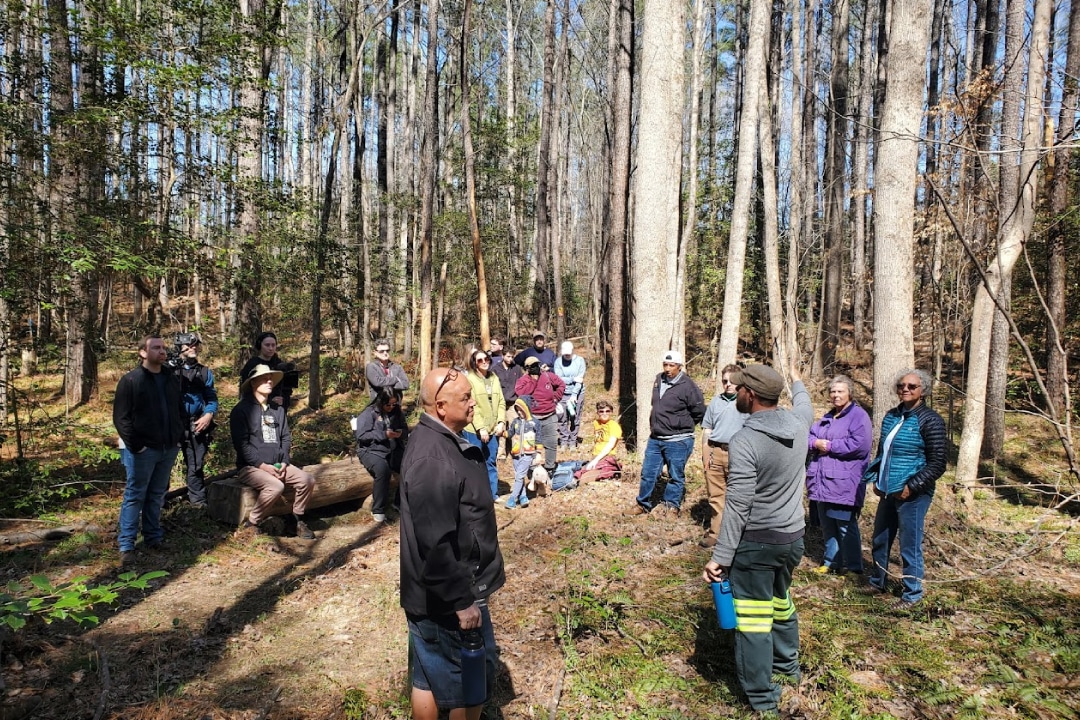
This case study documents the Chickahominy Indian Tribe-Eastern Division's (CIT-ED) innovative tribal food forest project, launched to combat climate change through enhanced environmental stewardship on ancestral lands. The initiative addresses multiple challenges: food insecurity, biodiversity loss, and greenhouse gas emissions by establishing a multi-layered forest garden that sequesters carbon, improves soil and water retention, and reduces reliance on transported produce. Spanning several acres, the food forest integrates fruit and nut trees (apples, pears, chestnuts), berry shrubs, nitrogen-fixing understory plants, groundcovers, and root crops in a permaculture-inspired design that mimics native ecosystems. Soil preparation emphasized minimal tillage, sheet mulching with local biomass, and biochar incorporation to build organic matter rapidly. Native species selection ensures adaptation to local hydrology and pollinators, while swales and keyline plowing capture rainwater, mitigating erosion and flooding—a critical issue in the Chesapeake Bay watershed. Carbon sequestration occurs via extensive root systems and leaf litter decomposition, estimated to lock away hundreds of tons of CO2 over decades, alongside methane reductions from shorter food supply chains. Water retention benefits recharge aquifers and filter pollutants, supporting tribal fisheries. Community involvement was central: tribal members, youth, and elders participated in planting events, knowledge-sharing workshops, and monitoring with soil sensors and carbon audits. Partnerships with regional NGOs provided funding, seedlings, and expertise, aligning with federal climate resilience grants. Early outcomes include thriving yields of traditional foods like pawpaws and persimmons, restored habitats for wildlife, and cultural revitalization through food sovereignty. Published in December 2025, the project exemplifies indigenous-led climate adaptation, demonstrating scalable models for other tribes. Challenges like invasive species and extreme weather were met with adaptive management, such as polyculture diversification. Broader impacts position the food forest as a carbon sink, educational hub, and economic driver via ecotourism and value-added products. This effort underscores how culturally attuned regenerative practices can yield ecological, social, and climatic dividends, inspiring global replication.
Source: allianceforthebay.org
Related Analysis
- DIY Root Cellar vs. Chest Freezer: Build Costs & Payback — A DIY in-ground or basement root cellar in the US costs roughly $500–$5,000 to build depending on method, while a chest …
- Worm Composting: 6 Ways to Build a Bin, Real 2026 Costs, and Where the Research Actually Disagrees — Vermicomposting turns kitchen scraps into worm castings using a container, bedding, and red wigglers (Eisenia fetida) — …
Related on PermaNews
- Designing Regenerative Resilience: Participatory Living Labs (How-To Guide)
- Lo—TEK: Indigenous Tech for Climate Solutions (Article)
- AUTarcaMatricultura La Palma: Permakultur & Energieautarkie (How-To Guide)
- Borneo's Rainforest Revival: Dr. Smits' Sugar Palm Village Hub (Case Study)
- Federal Policy Shift: Native Regenerative Ag for Soil & Carbon (Article)
- PRI Jordan: Arid Zone Permaculture Yields 5 Tons/Hectare (Case Study)
Explore more in Food Systems & Growing — the full hub for this knowledge area.