2026 Online PDC with Andrew Faust: Bioregional Living Center
By Andrew Faust Permaculture Consultant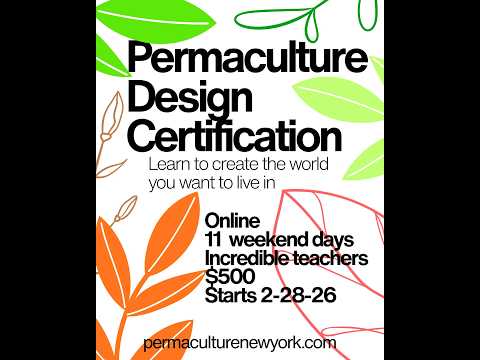
PermaNews Brief
Key Takeaways
An online Permaculture Design Certificate course in 2026 offers comprehensive training in permaculture principles and practical sustainable system design.
- Learn permaculture principles and practical applications.
- Design sustainable systems for diverse contexts.
- Understand soil health, water management, and plant systems.
- Explore ethical frameworks and site analysis methods.
- Integrate ecological, social, and economic factors.
Why It Matters
This course provides a structured pathway to implementing sustainable practices, crucial for addressing environmental challenges and fostering self-sufficiency.
What to Do Next
Enroll in the online Permaculture Design Certificate to gain a foundational understanding of sustainable living.
Recommended for: Individuals seeking a thorough education in permaculture design for personal application or professional development.
The Center for Bioregional Living is offering an online Permaculture Design Certificate (PDC) course in 2026, led by instructor Andrew Faust. This program is designed to provide a comprehensive understanding of permaculture principles and their practical application, enabling participants to design sustainable systems for various contexts, from urban gardens to larger landholdings. The course emphasizes a holistic approach, integrating ecological, social, and economic considerations into design processes.
The curriculum for this online PDC is structured to cover the core tenets of permaculture as established by its founders, Bill Mollison and David Holmgren. Participants will delve into topics such as observation and pattern recognition in nature, understanding different climate zones and their unique challenges, and the ethical framework that underpins permaculture design. A significant portion of the course will focus on practical design methodologies, including site analysis, zoning, sector analysis, and the strategic placement of elements within a system to maximize efficiency and resilience.
Key areas of study will include soil health and regeneration, which is fundamental to any sustainable system. The course will explore various techniques for building fertile soil, such as composting, vermiculture, and cover cropping, and discuss the importance of the soil food web. Water management is another critical component, with lessons on rainwater harvesting, greywater recycling, and designing for drought and flood resilience. Participants will learn about different irrigation strategies and how to create water-wise landscapes.
Beyond soil and water, the program will address plant systems, including edible landscapes, forest gardening, and agroforestry. It will cover plant guilds, companion planting, and the selection of appropriate species for specific bioregions. The role of animals in permaculture systems, from beneficial insects to livestock, will also be examined, focusing on how they can be integrated to enhance productivity and ecological balance.
The online format of the PDC allows for flexibility, making it accessible to a global audience. While delivered remotely, the course aims to foster a strong sense of community among participants through interactive sessions, discussion forums, and collaborative design projects. Andrew Faust, as the lead instructor, brings extensive experience in permaculture education and practical application. His teaching style is expected to integrate theoretical knowledge with real-world examples and case studies, encouraging students to apply permaculture thinking to their own environments.
A crucial aspect of this PDC is the emphasis on bioregional living, which encourages participants to understand and design within the specific ecological and cultural context of their local region. This involves studying local climate, geology, hydrology, and biodiversity, as well as engaging with local communities and resources. The goal is to create designs that are not only ecologically sound but also socially equitable and economically viable within their specific bioregion.
Upon successful completion of the course, participants will receive a Permaculture Design Certificate, a recognized credential in the field. This certificate signifies that the individual has a foundational understanding of permaculture principles and the ability to apply them in design. The skills acquired are applicable to a wide range of endeavors, from personal homesteading and community projects to professional consulting and landscape design. The 2026 online PDC offered by the Center for Bioregional Living, under the guidance of Andrew Faust, represents an opportunity for individuals to deepen their knowledge of sustainable living and contribute to the creation of more resilient and regenerative systems.
Source: youtube.com
Related Analysis
- City Leavers Build Off-Grid Homes Without Grid Connections — Early signals show urban-to-rural migrants building off-grid energy systems out of necessity, not principle — with long-…
- AI Hallucinated Links Are Breaking Permaculture Sites' Discoverability — Early signals indicate AI chatbots are generating fake URLs pointing to permaculture content, while site architecture—no…
Related on PermaNews
- Ernst Götsch's Cacao Syntropy: Master Agroforestry Now (How-To Guide)
- Finnish Off-Grid: Rocket Mass Heater Performance in Greenhouse (Case Study)
- Berlins schwimmende Gärten: Permakultur auf dem Wasser (Case Study)
- Rodale Report 2025: Thermal Mass Boost in Solar Greenhouses (Case Study)
- AUTarcaMatricultura La Palma: Permakultur & Energieautarkie (How-To Guide)
- Earthaven Ecovillage: 30 Years Off-Grid with Hydro & Solar (Video)
Explore more in Skills, Preparedness & Self-Reliance — the full hub for this knowledge area.