Stunning Off-Grid Tiny Home with Syntropic and Permaculture Food Forest Gardens
By Living Big In A Tiny House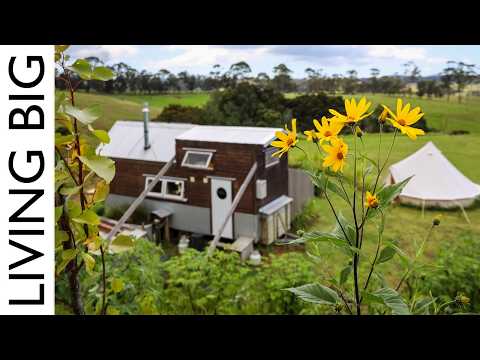
PermaNews Brief
Key Takeaways
A practical example of off-grid living through a productive food forest.
- Integrated tiny home and regenerative landscape
- Combination of syntropic agroforestry and permaculture
- DIY design prioritizing sustainability
- Small-scale food production on limited land
- Case study in regenerative living practices
Why It Matters
This project illustrates how compact homes can synergize with diverse agricultural systems, promoting efficient land use. It serves as a compelling model for eco-conscious living in limited spaces.
What to Do Next
Explore various permaculture methods tailored for compact spaces.
Permaculture Context
What this property demonstrates, beyond its visual appeal, is something practitioners often struggle to articulate to skeptics: that small-footprint living and high ecological productivity are not competing priorities but mutually reinforcing ones. The constraint of a tiny home forces design discipline that actually benefits the surrounding land, because less built environment means more acreage available for layered production systems. The combination of syntropic agroforestry with annual permaculture plantings is particularly instructive, because it reflects mature design thinking — syntropic systems build long-term soil capital and canopy structure, while annual beds provide immediate caloric and nutritional yield during the years before perennials fully establish. For anyone currently in the planning or early implementation stages of a homestead or eco-property, this case study reinforces a principle worth internalizing: design the dwelling as a component of the land system, not as its centerpiece. The DIY construction angle also matters practically, because owner-built structures typically allow greater integration flexibility — unusual roof angles for rainwater harvesting, siting decisions optimized for microclimates, and materials chosen for thermal performance rather than resale value alone.
Recommended for: Individuals interested in sustainable building and permaculture practices.
This video documents a real off-grid tiny home in far north New Zealand and shows how a compact dwelling can be integrated with a productive regenerative landscape. The most useful aspect is not the aesthetics of the house alone, but the way the property is described as a small-scale food forest that combines syntropic agroforestry and permaculture plantings. That makes it relevant to readers looking for concrete examples of housing plus land-use integration. The home is presented as a DIY-built structure crafted with timber, thoughtful spatial design, and creative use of materials, which suggests hands-on design decisions rather than a purely aspirational showcase. The surrounding landscape is described as a thriving food forest, and the narration explains syntropic agroforestry as a regenerative system that mimics natural ecosystems to produce food while restoring soil health and biodiversity. The inclusion of annual permaculture plantings adds another practical layer, showing that the site is not a single-method experiment but a mixed productive system. For practitioners, the value lies in seeing how a small residence can support or coexist with multiple food-production strategies on a limited property. This is especially relevant for people designing homesteads, eco-retreats, or low-impact rural properties, because it demonstrates a concrete pairing of small-footprint housing with layered perennial and annual production. The item is best understood as a case study in regenerative living, with the home functioning as one node in a larger living system rather than as an isolated building project.
Source: youtube.com
Related Analysis
- Campbell's Corporate Grants Push Farmers Into Regenerative Trials — Campbell's Grower Grants are funding real-acre regenerative trials, offering a corporate-backed mechanism for on-farm ex…
- Global Water Bankruptcy Forces Agricultural Adaptation — UN report reveals water bankruptcy across surface waters, glaciers, and groundwater, forcing immediate agricultural adap…
Related on PermaNews
- Ernst Götsch's Cacao Syntropy: Master Agroforestry Now (How-To Guide)
- Finnish Off-Grid: Rocket Mass Heater Performance in Greenhouse (Case Study)
- Berlins schwimmende Gärten: Permakultur auf dem Wasser (Case Study)
- Rodale Report 2025: Thermal Mass Boost in Solar Greenhouses (Case Study)
- AUTarcaMatricultura La Palma: Permakultur & Energieautarkie (How-To Guide)
- Earthaven Ecovillage: 30 Years Off-Grid with Hydro & Solar (Video)
Explore more in Food Systems & Growing — the full hub for this knowledge area.