Ancient Half-Moon Water Harvesting Revitalizes Arid Lands
By Annie Reneau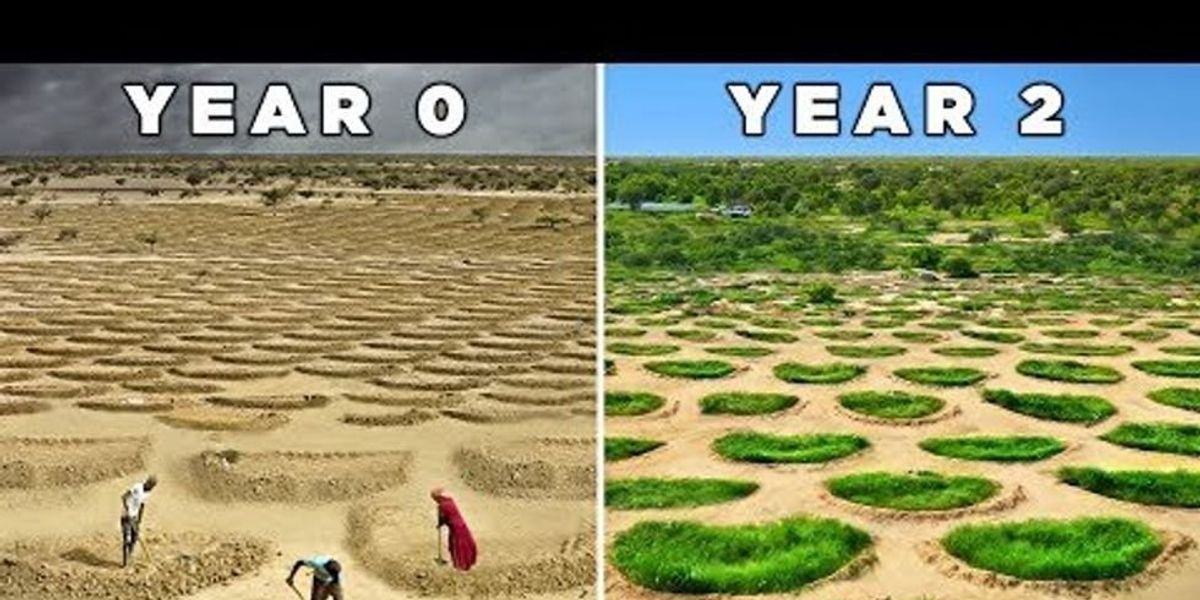
PermaNews Brief
Key Takeaways
Ancient half-moon trenches are revitalizing arid lands by capturing rainwater, transforming barren soil into productive farms and replenishing groundwater.
- Half-moon ditches capture rainwater, boosting soil moisture in dry regions.
- System enables growth of drought-resistant crops like sorghum and millet.
- Replenishes groundwater, promoting long-term water sustainability.
- Integrates indigenous wisdom with modern syntropic farming methods.
- Successfully rehabilitates degraded land, aids Great Green Wall initiative.
Why It Matters
This ancient technique offers a practical solution to desertification and food insecurity, creating fertile land from degraded areas and securing water resources for communities.
What to Do Next
Research local regulations and suitable indigenous plant species for implementing small-scale half-moon water harvesting systems in your own dryland garden or farm.
Recommended for: Farmers, permaculture practitioners, and environmental restorationists in dryland regions seeking scalable and sustainable water management solutions.
The article highlights the revival of the traditional half-moon water harvesting technique, a method involving digging semi-circular ditches that capture and hold rainwater to improve soil moisture in arid and degraded landscapes. Each half-moon is about four meters in diameter, with the straight side facing uphill to channel rainwater into the pit, while an embankment on the curved side retains the water. This technique enables rainwater to penetrate hard, sunbaked soils that otherwise repel moisture, facilitating the growth of native drought-resistant crops like sorghum and millet. The system not only supports immediate food production but also replenishes groundwater by allowing 10-15% of captured water to soak into the water table, promoting sustainable agriculture and environmental restoration. The approach integrates indigenous wisdom from the Sahel region and syntropic farming methods developed in Brazil, emphasizing soil rejuvenation and sustainable land use. It has been successfully used to rehabilitate barren wastelands, contributing to the Great Green Wall initiative aimed at combating desertification. The article underscores that this is an endogenous technology rediscovered and adapted to modern needs, offering a climate-smart, biodiversity-friendly solution that enhances food security and community resilience in drought-prone areas.
Source: upworthy.com
Related Analysis
- Designers Push Urban Standard From Sustainable to Regenerative — Early signals point to a push for urban design that actively restores ecosystems, not merely reduces harm — with field-t…
- Scrapped EV Batteries Convert to Solar Storage in Off-Grid Markets — Several sources suggest retired EV batteries are finding a second role in rural off-grid solar systems, potentially lowe…
Related on PermaNews
- Designing Regenerative Resilience: Participatory Living Labs (How-To Guide)
- Berlins schwimmende Gärten: Permakultur auf dem Wasser (Case Study)
- Lo—TEK: Indigenous Tech for Climate Solutions (Article)
- Finca Bellavista: Costa Rica's 200-Acre Water System Innovation (Case Study)
- Priya's 2024 India Report: 10-Hectare Water Harvesting Success (Case Study)
- Borneo's Rainforest Revival: Dr. Smits' Sugar Palm Village Hub (Case Study)
Explore more in Water, Climate & Adaptation — the full hub for this knowledge area.