Dürre-Frühling: Bewässerung in DE vor neuen Hürden
By DLG (Deutsche Landwirtschafts-Gesellschaft)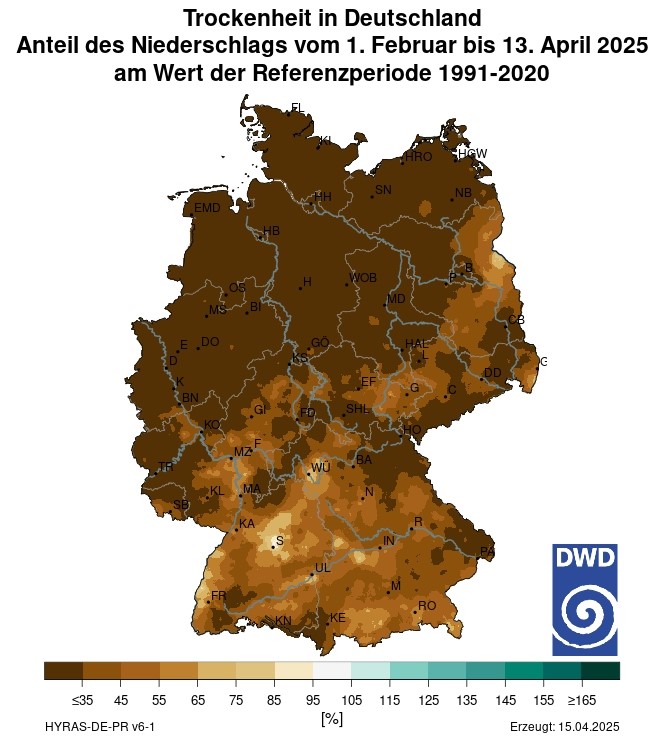
PermaNews Brief
Key Takeaways
Angesichts zunehmender Frühjahrstrockenheit in Deutschland sind angepasste und effiziente Bewässerungspraktiken entscheidend, um Ernteerträge und -qualität zu sichern.
- Frühlingstrockenheit erfordert angepasste Bewässerung.
- Moderne Technologien steigern Wassereffizienz.
- Bodenfeuchtemonitoring optimiert Bewässerung.
- Mulchen verbessert Wasserspeicherung im Boden.
- Regionale Unterschiede bei Bewässerungsbedarf und -quellen.
- Investitionen in Infrastruktur sind nötig.
Why It Matters
Die Sicherung der Nahrungsmittelproduktion wird durch den Klimawandel erschwert. Eine effiziente Bewässerung ist unerlässlich, um die Abhängigkeit von unregelmäßigen Niederschlägen zu verringern und die Ernteerträge zu stabilisieren. Dies trägt direkt zur regionalen Versorgungssicherheit bei.
What to Do Next
Informiere dich über lokale Förderprogramme für wassersparende Bewässerungstechnologien in deiner Region und prüfe, welche davon für deinen Betrieb geeignet sein könnten.
Recommended for: Landwirte, Gärtner und Agrarplaner, die effektive Strategien gegen Frühjahrstrockenheit suchen.
This article examines the increasing spring droughts in Germany and the consequential challenges for agricultural irrigation, arguing that adaptive and efficient irrigation practices are essential to sustain crop yields and quality under a changing climate. It begins by situating the problem within broader climatic trends: as drought periods become more frequent and severe, irrigation assumes a critical role in compensating for deficits in soil moisture and ensuring reliable production outcomes for farmers. The piece highlights regional heterogeneity in irrigation needs and infrastructure across Germany, noting that northern and eastern regions such as Niedersachsen and Brandenburg have relatively high proportions of irrigated land, while river valleys in Baden-Württemberg and Bavaria are important irrigation zones in the south. It explains that choice of water source for irrigation depends on regional availability and legal frameworks, with groundwater commonly used and alternative sources applied occasionally where permissible and feasible. The article evaluates a range of technological and management responses aimed at improving irrigation efficiency and sustainability. It underscores the importance of modern irrigation technologies—such as micro‑irrigation and drip systems—that reduce water losses and deliver water more precisely to the crop root zone, thereby increasing water‑use efficiency and crop resilience. Complementary measures discussed include implementation of soil moisture monitoring and sensor-based scheduling, precision‑farming approaches to match water application to crop needs, and mulching or other soil management practices that improve infiltration and water retention. Economic and institutional dimensions are considered: the piece notes that increasing irrigation demand can raise production costs for farmers and that water scarcity or regulatory limits may constrain irrigation in some regions. It argues for targeted investment in irrigation infrastructure and advisory services to help farms adopt efficient systems and manage limited water resources. The article also connects irrigation policy to national water governance, referencing the role of Germany’s National Water Strategy in guiding sustainable water use in agriculture and encouraging practices that balance agricultural needs with environmental protection. Environmental concerns—such as the impacts of groundwater abstraction, potential conflicts over water allocation, and the need to protect aquatic ecosystems—are recognized, leading to a call for integrated planning that aligns irrigation expansion with long‑term resource sustainability. Finally, the article emphasizes regional adaptation: it recommends tailoring irrigation strategies to local climatic, hydrological and agronomic conditions, combining technological measures with soil and crop management, and strengthening governance and funding mechanisms to support a resilient agricultural sector. The overall conclusion is that efficient, targeted irrigation investments and practices, implemented within a coherent water‑management framework, are key to maintaining agricultural productivity and quality under increasing spring drought risk.
Source: dlg.org
Related Analysis
- California Homesteaders Retrofit Greywater Before Drought Season — Several sources suggest CA homesteaders are retrofitting greywater systems ahead of drought season, prioritizing water r…
- Earthworks Retrofits Outperform Tech in Farm Drought-Proofing — Several regenerative farm case studies show earthworks and cascading storage systems achieving 2–3x water retention gain…
Related on PermaNews
- Exploring Permaculture with Geoff Lawton in Australia (Video)
- Essential Role of Topsoil in Earth's Life Systems (Video)
- Ivana Gazibara's $1.4B Initiative to Revamp Midwest Agriculture (Video)
- New York State's Climate Impact Strategies: Case Study Insights (Case Study)
- UK's 2025 Climate Adaptation Progress Report Unveiled (Article)
- Rosemary Morrow on Permaculture for a Changing Planet (Podcast)
Explore more in Water, Climate & Adaptation — the full hub for this knowledge area.