Cassava Planting Guide: From Stem Cuttings (Part 2)
By Discover Permaculture with Geoff Lawton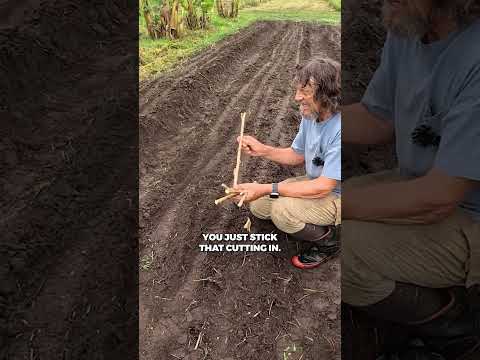
TL;DR: Propagate cassava efficiently from stem cuttings for a resilient food forest addition, ensuring proper cutting selection and planting techniques.
- Select woody stems from mature plants at least eight months old.
- Cuttings should be 20-30 cm with several nodes for root and leaf growth.
- Strip leaves to reduce moisture loss and encourage root development.
- Plant cuttings with the correct orientation to ensure successful growth.
- Consider vertical, angled, or horizontal planting based on soil conditions.
Why it matters: Cassava is a highly versatile and resilient crop, making its successful propagation crucial for establishing productive permaculture systems and enhancing food security.
Do this next: Prepare cassava stem cuttings by stripping leaves and ensuring correct orientation for planting.
Recommended for: Anyone interested in expanding their food forest with a highly productive root crop using straightforward propagation techniques.
This article, the second in a series, details the process of planting cassava, a versatile and resilient crop often utilized in permaculture systems. The primary method for propagating cassava is through stem cuttings, which are essentially sections of the mature plant's stem. The ideal cuttings are taken from the woody, mature parts of the stem, typically from plants that are at least eight months old. These cuttings should be about 20 to 30 centimeters (approximately 8 to 12 inches) in length and possess several nodes, which are the points on the stem where leaves and roots can emerge.
Before planting, it's beneficial to prepare the cuttings. One common technique involves stripping off any remaining leaves from the cutting to reduce moisture loss through transpiration, allowing the plant to focus its energy on root development. Some growers also recommend treating the cuttings with a rooting hormone, although cassava is generally quite vigorous and can root successfully without it. The ends of the cuttings can also be dipped in a fungicide solution to prevent rot, especially in humid or wet conditions.
When it comes to planting, the orientation of the cutting is crucial. Cassava cuttings have a distinct top and bottom, corresponding to how they grew on the parent plant. The top end, which was closer to the growing tip, should be planted facing upwards, and the bottom end, which was closer to the roots, should be planted facing downwards. Planting them upside down will significantly hinder or prevent growth.
There are several ways to plant cassava cuttings. One common method is to plant them vertically, burying about two-thirds of the cutting into the soil, leaving one-third exposed. Another approach is to plant them at an angle, which some believe encourages more root development. A third method involves planting them horizontally, just beneath the soil surface. This can be particularly useful in areas with very sandy soil or where there's a risk of the cuttings drying out quickly. Regardless of the method, the soil should be well-drained and loose enough to allow for easy root penetration.
The spacing between cassava plants depends on the desired outcome. For a dense planting that maximizes yield per area, plants can be spaced closer together, perhaps 60 to 90 centimeters (2 to 3 feet) apart. If the goal is to produce larger tubers or to allow for intercropping with other plants, wider spacing, such as 1 to 1.5 meters (3 to 5 feet), might be more appropriate.
Cassava thrives in full sun and prefers well-drained soil. While it can tolerate a range of soil types, it performs best in sandy loams. It's also remarkably drought-tolerant once established, making it a valuable crop in regions with unreliable rainfall. However, consistent moisture during the initial rooting phase is beneficial for strong establishment.
After planting, it's important to provide initial watering to help settle the soil around the cuttings. Subsequent watering should be done as needed, avoiding waterlogging. Weeding around the young plants is also crucial to reduce competition for nutrients and water. Cassava is generally a low-maintenance crop, but a little care in the early stages can significantly improve its establishment and overall yield. The plant typically takes 8 to 12 months to mature, at which point the tubers can be harvested. The leaves are also edible and nutritious, offering an additional food source.