People-Powered Seed: Co-op & Community Innovation
By SeedChange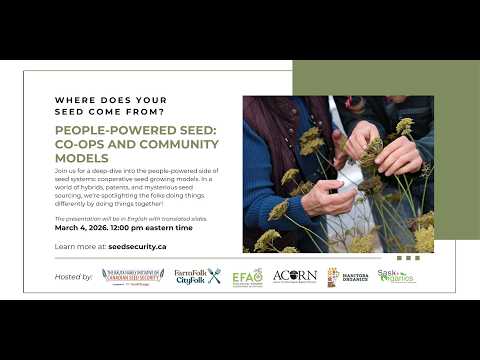
PermaNews Brief
Key Takeaways
Community and cooperative models offer robust solutions for seed saving, distribution, and resilience in regenerative agriculture.
- Seed co-ops enhance regionally adapted, organic seed production.
- Community seed bees foster skill-sharing and social connections.
- Cooperative models address rural isolation for small growers.
- Collective breeding ensures diverse, climate-resilient varieties.
- Democratic processes guide seed variety maintenance and adaptation.
Why It Matters
Implementing community-powered seed systems boosts local food security, preserves biodiversity, and builds resilient agricultural practices.
What to Do Next
Explore local seed-saving groups or co-ops in your area to get involved.
Recommended for: Farmers, gardeners, permaculture practitioners, and community organizers interested in sustainable seed systems and food sovereignty.
This expert-led webinar features practitioners Arzeena Hamir from BC Eco-seed Co-op, Christina Henatsch from Kultursaat, and Owen Taylor from TrueLove Seeds, providing a deep dive into people-powered seed systems tailored for regenerative living and self-sufficiency. The discussion covers practical co-op and community models for seed saving, distribution, and resilience-building, particularly in permaculture contexts. Arzeena Hamir shares insights from BC Eco-seed Co-op, a farmer-led initiative in British Columbia that focuses on producing and distributing regionally adapted, organic seeds. They emphasize community involvement in seed cleaning bees, where members gather to process harvested seeds using simple tools like threshers made from bicycle wheels and tarps, fostering skill-sharing and social bonds essential for self-sufficient networks. Hamir details field-tested implementations, such as growing seeds on small plots integrated into vegetable farms, with specifics on crop selection like beans, peas, and brassicas that are easy for beginners to save. Challenges like isolation in rural areas are addressed through co-op models that pool resources for processing and marketing, enabling small-scale growers to access larger markets without individual investment in infrastructure. Christina Henatsch from Kultursaat, a German seed cooperative, explains their model of collective breeding and selection for open-pollinated varieties resilient to local climates. They highlight democratic decision-making processes where members vote on variety maintenance, ensuring genetic diversity and adaptation to changing conditions like drought or pests, crucial for regenerative agriculture. Practical details include member commitments to grow specific varieties, with co-op support for pollination isolation techniques using distance or bagging, and post-harvest cleaning protocols to maintain high germination rates above 85%. Owen Taylor from TrueLove Seeds discusses grassroots community seed libraries and swaps, integrating them with permaculture designs for on-farm seed production. He covers real-world examples of seed inoculation techniques to boost soil biology, reducing fertilizer needs by enhancing microbial activity, with data from northern short-season trials showing 20-30% yield improvements in cover-cropped systems. Intercropping specifics, like combining nitrogen-fixers with seed crops, are outlined for micro-farms scaling to row crops. The panel addresses scaling challenges, such as balancing vegetable production with seed growing by dedicating 5-10% of land to seeds, and using low-effort methods like no-till harvesting to minimize labor. Resilience-building strategies include seed swaps at permaculture gatherings, online catalogs for distribution, and education on isolation distances (e.g., 1km for corn, 500m for squash). Economic models are dissected, with co-ops retaining 60-70% margins for reinvestment in community programs like free seeds for new gardeners. The session provides actionable steps for starting a local co-op: form a core group of 5-10 committed savers, host workshops on basic techniques (e.g., fermenting tomato seeds), establish bylaws for quality control, and partner with local markets for sales. These field-tested approaches empower self-sufficient networks by decentralizing seed supply, reducing reliance on commercial hybrids, and building adaptive food systems amid climate uncertainty.
Source: youtube.com
Related Analysis
- High-Salt Fertilizers Block Soil Microbes, Kempf Says — High-salt fertilizers disrupt soil microbes and microbial colonization, trapping farmers in chemical dependency. Biologi…
- Fertilizer Shortage Forces Reckoning on Nitrogen Sources — Fertilizer supply crisis drives farms toward nitrogen-fixing cover crops, compost, and legume rotations as alternatives.
Explore more in Food Systems & Growing — the full hub for this knowledge area.