Bio-Nanofertilizers: Next-Gen Soil Health for Sustainable Farms
By Samukarani Swain, Lala Behari Sukla, D. P. Krishna Samal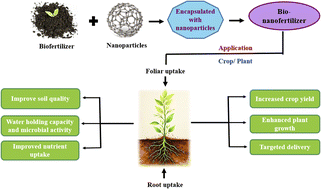
TL;DR: Bio-nanofertilizers offer a promising, eco-friendly alternative to chemical fertilizers, enhancing crop yields and soil health while reducing environmental impact.
- Next-gen BNFs boost nutrient delivery and crop yields significantly.
- They improve soil health by increasing microbial diversity.
- Application rates are lower, reducing environmental pollution risks.
- BNFs enhance plant stress tolerance to drought and salinity.
- Green nanotechnology offers sustainable synthesis methods.
Why it matters: The agricultural sector faces increasing pressure to produce more food sustainably. Bio-nanofertilizers offer a pathway to achieve this by improving efficiency and reducing the ecological footprint of farming.
Do this next: Explore local agricultural research institutions for ongoing trials or pilot programs involving bio-nanofertilizers for relevant crops.
Recommended for: Farmers, agricultural policymakers, and researchers interested in advanced sustainable farming techniques and soil health management.
This scientific review article explores the transformative potential of bio-nanofertilizers (BNFs) as eco-friendly alternatives to conventional chemical fertilizers, aiming to revolutionize agroecosystems for sustainable agriculture. Authored by Samukarani Swain, Lala Behari Sukla, and D. P. Krishna Samal, the paper details how BNFs integrate nanotechnology with biological agents like microbes and plant extracts to enhance nutrient delivery. Unlike traditional fertilizers that lead to runoff, soil degradation, and greenhouse gas emissions, BNFs offer controlled-release mechanisms, improving nutrient use efficiency (NUE) by up to 30-50%. Field trials cited show crop yield increases of 24-32% for staples like rice, wheat, and maize, attributed to nano-encapsulated nitrogen, phosphorus, and potassium that target root zones precisely. Soil health benefits include elevated microbial diversity, reduced salinity, and improved organic carbon levels, fostering long-term fertility. Environmental impacts are minimized through lower application rates—up to 50% less—and decreased leaching into waterways, mitigating eutrophication and water pollution. The review covers synthesis methods, such as green nanotechnology using plant-derived nanoparticles, and characterization techniques like SEM, TEM, and FTIR for quality assurance. Challenges discussed include scalability, cost barriers for smallholders, regulatory hurdles, and potential nano-toxicity, with solutions like cost-effective production via microbial fermentation and risk assessment protocols. Case studies from India and Southeast Asia demonstrate real-world efficacy, with BNFs enhancing stress tolerance to drought and salinity via osmoprotectants. Economic analyses reveal return on investment through higher yields and reduced input costs, supporting farmer adoption. The authors advocate policy incentives, public-private partnerships, and further R&D for commercialization. Projections indicate BNFs could contribute to global sustainable development goals by 2030, aligning with UN SDGs on zero hunger, climate action, and life on land. This overview positions BNFs as a cornerstone for precision agriculture, bridging nanotechnology and biology to create resilient, low-impact farming systems that sustain food security while preserving ecosystems.