The Future of Energy" Review: Timely But Fundamentally Flawed
By Nick Rosen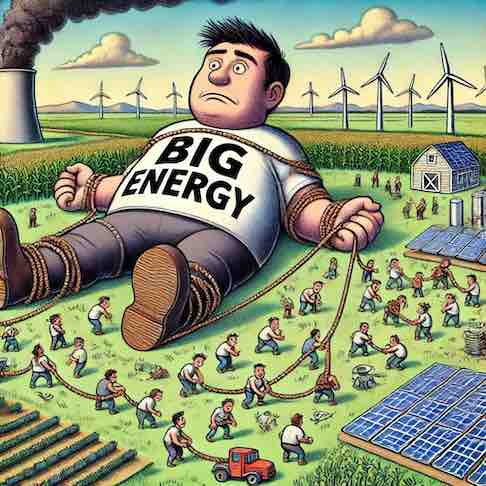
TL;DR: A new book on energy fails to envision a truly transformative future, instead promoting a slightly greener version of the status quo.
- New energy book is well-researched but conventional.
- Author's vision aligns with current UK government strategies.
- Book promotes large corporations as climate solution providers.
- Off-grid solutions are mentioned but not fully explored.
- Reviewer criticizes lack of imagination for energy's future.
Why it matters: Understanding diverse perspectives on energy transitions is crucial for shaping sustainable practices and avoiding greenwashing.
Do this next: Research local initiatives for community-led renewable energy projects.
Recommended for: Those interested in the broader discourse around renewable energy and critical analyses of mainstream environmental proposals.
Richard Black's recent book, "The Future of Energy," is recognized for its thorough research, timely relevance, and engaging writing style, especially considering its complex subject matter. However, the reviewer contends that the book's central premise regarding the future of energy is fundamentally misdirected.
Black, a former environmental science journalist for the BBC, is noted for his departure from the organization due to the challenging climate of accusations from climate change deniers and the pervasive greenwashing efforts by large corporations entering the environmental technology sector. His perspective largely aligns with current UK government strategies, particularly the Great British energy investment vehicle, which is designed to allocate its budget, albeit modest, to support various clean energy startups, primarily larger ones.
The book's core argument posits that fossil fuels—coal, oil, and gas—are detrimental, while clean energy is beneficial. While this statement holds a degree of truth, the reviewer argues that Black's vision for the future of energy is overly conventional. Despite acknowledging historical distrust of government and the influence of entities like the Rockefeller oil dynasty, Black appears to endorse the prevailing industry consensus. This consensus suggests that the future energy system will largely mirror the past, but with cleaner operations, allowing for a continuation of current lifestyles and practices, with large corporations delivering clean energy solutions to address climate issues.
The reviewer expresses disappointment with this conclusion, finding it particularly odd given a brief section in the book that touches upon off-grid energy solutions. Specifically, pages 43-46 of the 200-page book highlight Black's perspective on the empowering potential of a clean energy system. He states that it enables individuals and businesses to make independent choices, freeing them from reliance on traditional energy sources like coal for heating, petrol for vehicles, and gas for boilers. Black further elaborates on the benefits of peer-to-peer (P2P) energy trading, where electricity is consumed near its generation point, thereby reducing the necessity for extensive transmission infrastructure such as large cables, substations, and other grid components.
The reviewer challenges Black's mainstream view of the centralized grid, which, like many commentators, Black advocates for "decarbonizing, strengthening, and extending." The reviewer asserts that the centralized grid is more a part of the problem than a solution.
Black's alignment with current mainstream thought is acknowledged, but the reviewer suggests a critical oversight. By primarily focusing on the negative aspects of oil, gas, and coal, Black inadvertently supports the agenda of the nuclear industry. The reviewer speculates that energy industry executives would welcome the cessation of oil use, anticipating significant financial benefits. While Black criticizes groups like Just Stop Oil for their performative activism, the reviewer argues that Black makes a similar error by misidentifying the primary antagonist. The issue, according to the reviewer, is not solely "Big Oil" but rather "Big Energy" as a whole.