Quitting 9-to-5 to Build a Permitted Off-Grid Homestead in Northeast France
By Kirsten Dirksen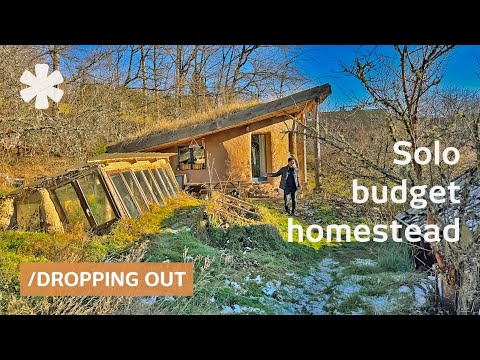
This video presents a concrete off-grid homestead case study centered on Mathieu Munsch, who left a conventional salaried life to build a small, permitted home on a sloping meadow in northeast France. The strongest practical value in the piece is its specificity: the build is intentionally limited to 50 m² so it could be designed by the owner without hiring an architect or engineer, with a friend in engineering reviewing the calculations. The home is built from local and low-impact materials, including earth from the site, nearby wood, and straw bales sourced from local farmers. That combination makes the project relevant to regenerative living because it shows how material sourcing, building scale, and labor decisions can reduce cost and complexity while staying aligned with ecological goals. The living system is also described in operational terms. The home runs off-grid on roughly €200 per month, using solar panels for electricity, solar thermal for hot water in summer, and a wood stove for winter heat and water heating when needed. Water access is handled without municipal supply: groundwater is encouraged into an underground pipe and stored in a cistern placed halfway down the hill, taking advantage of the terrain’s slope. The project also extends beyond the primary dwelling, with a second earth unit under construction in a Japanese-style form intended as a bathhouse. Interior construction details are mentioned as well, including woven willow branches coated with earth for wall surfaces, indicating a practical natural-building method rather than a purely conceptual one. For practitioners interested in self-sufficiency, this is useful because it combines building size strategy, local-material sourcing, passive site planning, water capture/storage, and a mixed-energy approach across seasons. It is more of a real-world build profile than a theoretical guide, and it offers concrete design choices that can be compared against other off-grid homestead models.
Source: youtube.com
Related Analysis
- Homeowners Retrofit Properties with Renewable Energy Solutions — Renewable energy retrofitting gains traction as regenerative agriculture principles inform home upgrades. Experts point …
- New Practices Build Climate-Resilient Cob Homes — Cob construction emerges as a key strategy in enhancing resilience against ecological challenges in permaculture systems…
Related on PermaNews
- Finnish Off-Grid: Rocket Mass Heater Performance in Greenhouse (Case Study)
- Rodale Report 2025: Thermal Mass Boost in Solar Greenhouses (Case Study)
- Earthaven Ecovillage: 30 Years Off-Grid with Hydro & Solar (Video)
- Borneo's Rainforest Revival: Dr. Smits' Sugar Palm Village Hub (Case Study)
- Holmgren's 40 Yrs: Abundant Permaculture Design Webinar 3 (Video)
- 2025: Rocket Mass Heaters in PHI-Certified Earthship Tiny Homes (Case Study)
Explore more in Shelter, Energy & Infrastructure — the full hub for this knowledge area.