Morocco Living Labs: Efficient Irrigation & Water Conservation
By NATAE Agroecology Project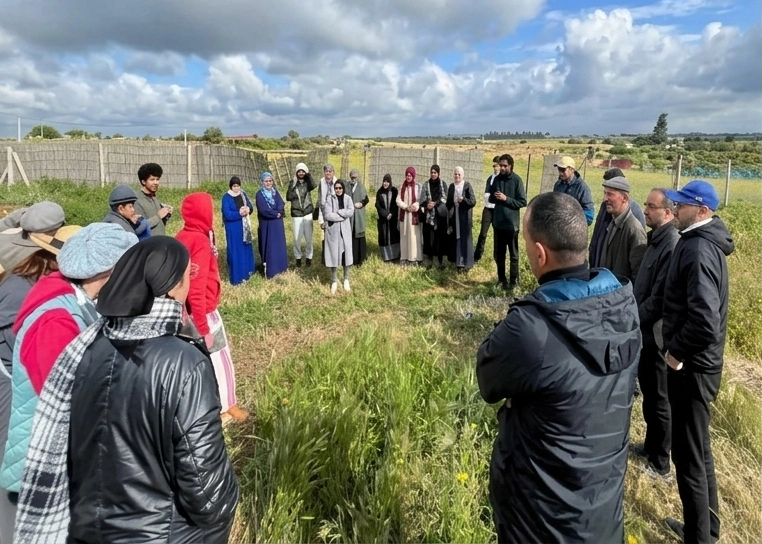
TL;DR: Hands-on workshops in Morocco demonstrate efficient irrigation, water conservation, and regenerative farming practices for semi-arid regions.
- Drip irrigation reduces water use by 40-60%.
- Mulching with local materials cuts evaporation by 30%.
- Cover cropping improves soil moisture and organic matter.
- Agroforestry enhances infiltration and pest control.
- Bio-pesticides minimize chemical runoff.
- Tensiometers enable real-time moisture monitoring.
Why it matters: Implementing these strategies can significantly reduce water consumption, enhance crop resilience, and improve soil health in water-scarce environments.
Do this next: Explore drip irrigation retrofits for your farm using pressure-compensating drippers and appropriate emitter spacing.
Recommended for: Farmers, agricultural technicians, and permaculture designers seeking field-tested methods for climate-resilient food production in water-stressed regions.
This field report from the NATAE Agroecology Project documents three-day hands-on workshops in Morocco's living labs, delivering practitioner-led training on efficient irrigation and water conservation integrated with regenerative agroecology principles. Sessions focused on drip irrigation system retrofits for smallholder farms, including layout design for 1-hectare plots with emitter spacing at 30-50 cm, pressure-compensating drippers (1-2 L/h), and fertigation schedules reducing water use by 40-60% compared to flood methods. Water conservation strategies emphasized mulching with local olive prunings (10-15 cm layer) to cut evaporation by 30%, alongside cover cropping with vetch and barley mixes to boost soil moisture retention via enhanced microbial activity and organic matter buildup. Biodiversity integration featured agroforestry trials planting nitrogen-fixing acacias alongside crops, improving infiltration by 25% and supporting pest control through companion planting (e.g., marigolds for nematodes). Crop protection modules taught bio-pesticide applications like neem extracts, minimizing chemical runoff and preserving aquifer quality. Practical exercises included soil pit digs to assess texture and install tensiometers for real-time moisture monitoring, enabling irrigation only at 50-60% depletion thresholds. Outcomes from lab sites showed yield stability under 30% less water, with groundwater recharge estimates via piezometer data indicating 15-20% uplift. The report provides replicable protocols, participant feedback on scalability for semi-arid contexts, and links to NATAE toolkits for sensor-based scheduling apps. This resource equips regenerative practitioners with concrete, field-tested methods for transitioning arid agroecosystems, emphasizing co-design with farmers for long-term adoption and resilience against drought cycles.