LA Wildfires: Grid Faults Linked to 3 Blazes
By Nick Rosen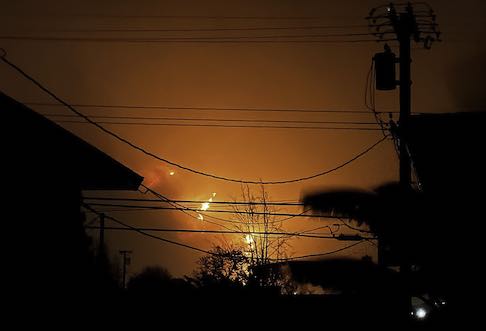
PermaNews Brief
Key Takeaways
New research suggests electrical grid failures, not just extreme weather, were a primary cause of three major LA wildfires.
- Power grid faults spiked before LA wildfires.
- Faults create sparks, igniting dry vegetation.
- Poorly maintained power lines are a recurring issue.
- Insurance action against utilities is a possibility.
- De-energizing power lines is a critical question.
Why It Matters
Understanding the direct link between power infrastructure and wildfires can inform better prevention strategies and accountability for utility companies.
What to Do Next
Research local utility maintenance schedules and fire prevention efforts in your area.
Recommended for: Anyone concerned about wildfire prevention, infrastructure resilience, and corporate accountability in climate disaster contexts.
Research conducted by Whisker Labs, a company specializing in electrical activity monitoring, indicates a significant increase in power grid faults in the vicinity of three major Los Angeles County wildfires shortly before their ignition. This evidence suggests a potential link between the electrical infrastructure and the devastating fires, implying that the grid itself, rather than solely extreme weather conditions, might be a primary factor in their initiation.
Bob Marshall, the chief executive of Whisker Labs, reported to The LA Times that areas near the Eaton, Palisades, and Hurst fires experienced substantial surges in electrical faults in the hours preceding the blazes. These faults, which can result from various incidents such as tree limbs contacting power lines or wires touching each other, generate sparks capable of igniting dry vegetation, leading to rapid wildfire development. This phenomenon highlights a recurring issue where inadequately maintained power lines, combined with environmental factors, contribute to the spread of large-scale fires. The recent findings by Whisker Labs suggest this scenario played out in Los Angeles County.
The article raises several critical questions: the rationale behind not de-energizing power lines, the possibility of insurance companies pursuing legal action against utility providers, and whether utility executives might face criminal charges.
Focusing on the Palisades Fire, which became one of Los Angeles's most destructive fires, it consumed approximately 17,000 acres and destroyed over 5,000 homes, exacerbated by strong Santa Ana winds exceeding 100 mph. While these winds created a conducive environment for fire spread, the role of power lines is highlighted as a crucial element. Whisker Labs' data indicates that power lines were already sparking in the area as the fire began to intensify. A similar pattern of dangerous levels of power grid faults was observed in the days leading up to the fire's full development.
This pattern suggests a systemic issue with the power grid, where even minor incidents like a falling tree branch can trigger a wildfire. When combined with high winds, these sparks can become an uncontrollable force, fueled by arid conditions and a climate increasingly susceptible to extreme weather events.
The article draws a parallel to the Northern California wildfires of October 2017, which burned 250 square miles, destroyed 6,000 homes and businesses, and resulted in 44 fatalities. Over seven years later, the exact cause of these fires remains undetermined, though the private utility company Pacific Gas and Electric (PG&E) is under investigation. The total damages from the Northern California wildfires amounted to $9 billion, and PG&E has reportedly begun accumulating financial reserves.
Source: off-grid.net
Related Analysis
- Off-Grid Homesteads Merge Thermal and Electrical Renewable Systems — Several 2024–2025 case studies show off-grid permaculture sites pairing rocket mass heaters with solar or micro-hydro el…
- Off-Grid Solar Projects Shed Legacy Batteries for LFP — Several sources suggest LFP batteries are becoming the go-to storage solution as solar adoption grows across off-grid an…
Related on PermaNews
- New York State's Climate Impact Strategies: Case Study Insights (Case Study)
- UK's 2025 Climate Adaptation Progress Report Unveiled (Article)
- Rosemary Morrow on Permaculture for a Changing Planet (Podcast)
- How One Industry Erased 4 Billion Trees in 40 Years (Video)
- Is Innovative Design a Solution to Climate Change Challenges? (Video)
- Gesundheit der Zukunft: Claudia Traidl-Hoffmann im Changemaker-Podcast (Podcast)
Explore more in Shelter, Energy & Infrastructure — the full hub for this knowledge area.