RetroSuburbia: Downshift for a Resilient Future
By David Holmgren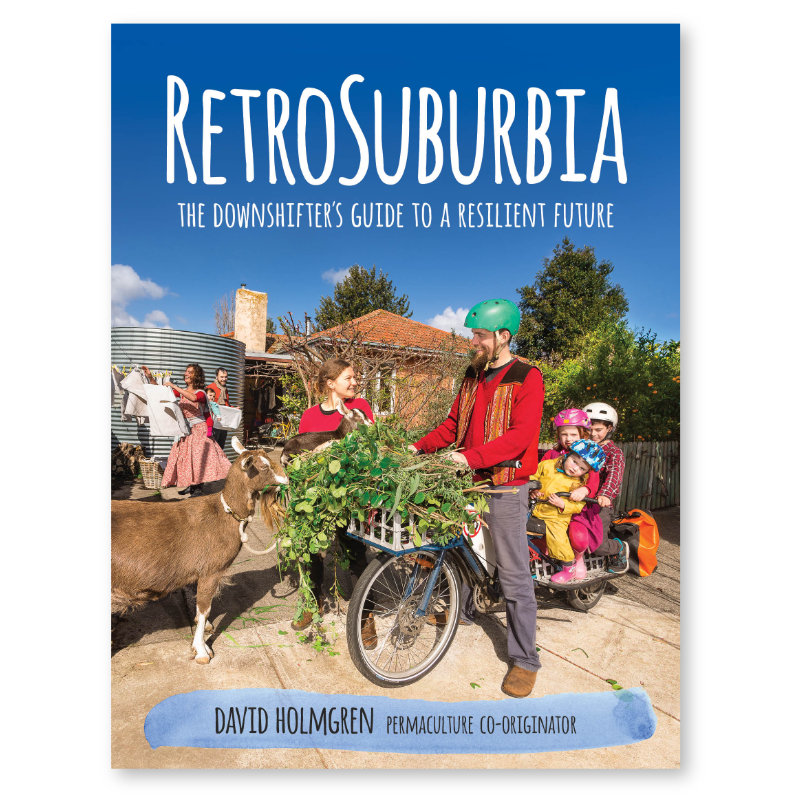
TL;DR: RetroSuburbia guides homeowners in transforming their properties and lifestyles for sustainability and resilience amidst environmental and economic changes.
- Retrofit homes and gardens for increased productivity.
- Apply permaculture thinking to suburban living.
- Reduce reliance on external systems.
- Integrate renewable energy solutions.
- Foster community-level resilience.
Why it matters: This guide offers a comprehensive framework for individuals and households to proactively adapt to future challenges, enhancing self-reliance and environmental stewardship.
Do this next: Start by identifying one area in your home or garden where you can implement a small-scale permaculture design.
Recommended for: Homeowners, permaculture practitioners, and individuals interested in creating resilient and sustainable living systems within suburban environments.
RetroSuburbia by David Holmgren focuses on downshifting and retrofitting homes, gardens, communities, and selves for sustainability and resilience in energy descent. The first section explores big-picture issues and thinking tools like permaculture and pattern languages for household responses to future challenges. It outlines connections between personal/global issues, positioning suburbs as survival/thriving places via one-household-at-a-time retrofits. Practical guidance includes transforming homes into productive systems, with online previews detailing strategic overhauls. Holmgren, co-originator of permaculture via Permaculture One (1978), emphasizes practical projects and teaching by example. The book provides design patterns for perennial suburban problems, promoting permaculture's philosophical foundations. Actionable elements cover insulation, renewable energy integration, garden yields, waste minimization, and community patterns. It equips readers with tools to retrofit amid economic/climate shifts, using ethics like fair share and principles for integrated solutions. Specifics include household-level strategies scalable to neighborhoods, with references to technical sources and demonstrations like Melliodora. This manual delivers concrete steps for practitioners to achieve self-reliance, reducing dependence on fragile systems through permaculture-designed resilience.