No-Soil Hugelkultur: Clay & Sand Solutions
By paul wheaton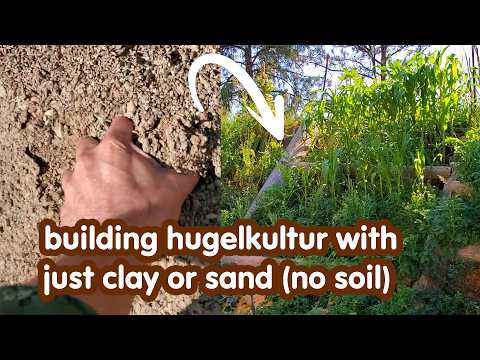
TL;DR: Hugelkultur beds can be adapted for challenging clay or sandy soils by modifying drainage and water retention strategies.
- Clay soils need robust drainage layers and organic matter.
- Sandy soils require enhanced water retention measures.
- Wider, gently sloped bases improve water distribution.
- Gravel, rocks, and coarse materials aid drainage.
- Organic matter improves clay structure over time.
Why it matters: Building hugelkultur in challenging soil types improves soil health and water management, expanding regenerative gardening possibilities.
Do this next: Consider your native soil type when planning a hugelkultur bed to determine necessary modifications.
Recommended for: Gardeners and land stewards looking to implement hugelkultur in less-than-ideal soil conditions.
This article addresses the challenge of constructing a hugelkultur bed in environments where the existing soil is either predominantly clay or sand, rather than the ideal loamy topsoil. The core principle of hugelkultur involves burying wood and other organic materials to create a raised garden bed that retains moisture and nutrients, mimicking natural forest decomposition processes. However, the success of this method is heavily influenced by the surrounding soil type.
When dealing with a site primarily composed of clay, the primary concern is drainage. Clay soil is dense and compact, hindering water percolation and potentially leading to waterlogging within the hugelkultur mound. To counteract this, the article suggests several strategies. Firstly, it emphasizes the importance of creating a robust drainage layer at the base of the hugelkultur. This can involve incorporating coarser materials like gravel, small rocks, or even larger pieces of wood that will decompose slowly, creating air pockets and pathways for water. Secondly, it recommends incorporating significant amounts of organic matter that will break down and improve the clay's structure over time. This includes not just the wood core, but also layers of leaves, straw, wood chips, and compost. These materials will gradually lighten the clay, making it more friable and permeable. Another crucial step is to consider the shape of the hugelkultur. A wider, more gently sloped base can help distribute water more effectively than a narrow, steep one, reducing the risk of water pooling. Additionally, if possible, digging a shallow trench around the base of the hugelkultur and filling it with coarse material can further aid in diverting excess water.
Conversely, building a hugelkultur on sandy soil presents the opposite challenge: water retention. Sand drains very quickly, meaning that the moisture-holding benefits of the buried wood might be diminished if the surrounding soil cannot hold onto water. In this scenario, the article advises focusing on materials that will significantly increase the water-holding capacity of the bed. The wood core remains essential, as decaying wood acts like a sponge. However, the layers surrounding the wood should be rich in fine organic matter. This includes well-rotted compost, peat moss (if sustainably sourced), biochar, and even finely shredded leaves. These materials have a high cation exchange capacity and can absorb and hold onto water and nutrients that would otherwise leach away in sandy soil. The article also suggests incorporating a "clay amendment" if available, even in small quantities. A thin layer of clay, or even a clay-rich soil mixed into the sandy layers, can dramatically improve water retention. Furthermore, mulching the surface of the hugelkultur with a thick layer of organic material is particularly important in sandy environments to reduce evaporation and protect the soil from the sun's drying effects.
Regardless of whether the base soil is clay or sand, the article stresses the importance of layering. A successful hugelkultur is not just a pile of wood; it's a carefully constructed ecosystem. Each layer, from the large logs at the bottom to the finer organic matter and topsoil, plays a role in the overall function of the bed. The article also highlights the long-term benefits of hugelkultur, noting that while the initial construction might require more effort in challenging soil types, the resulting beds will become increasingly fertile and self-sustaining over many years, requiring less irrigation and fertilization than conventional gardens. The key is to understand the limitations and opportunities presented by the existing soil and to adapt the hugelkultur design accordingly, using materials that either improve drainage or enhance water retention as needed.