Holland Park: 10-Day Rammed Earth Eco Build in UK Cold
PermaNews Brief
Key Takeaways
Rammed earth construction offers a sustainable building solution, proven feasible even in challenging conditions with minimal experience.
- Rammed earth construction is viable for eco-buildings in temperate climates.
- Minimal experience is needed with enthusiastic teams.
- Local, low-cost materials reduce environmental impact.
- Thermal mass benefits stabilize indoor temperatures naturally.
- Soil selection and mixing ratios are crucial for durability.
Why It Matters
This case study demonstrates that regenerative building practices, like rammed earth, are accessible and effective for creating thermally stable and environmentally friendly structures.
What to Do Next
Research local soil compositions and availability for rammed earth potential in your area.
Recommended for: Anyone interested in sustainable building practices, particularly those exploring alternative construction methods for thermal efficiency.
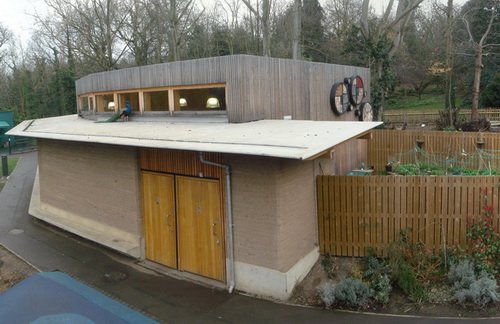
The Holland Park Rammed Earth Eco Centre serves as a practical case study in sustainable construction using rammed earth, demonstrating feasibility even under challenging conditions. Constructed over just ten days amid sub-zero temperatures in the UK, the project was executed by a team with minimal prior experience but high enthusiasm, highlighting the accessibility of the technique for non-experts. The material used was a mixture of grey brick clay and 'twenty to dust,' a red crushed limestone, compacted into walls that leverage earth's natural properties. Rammed earth, though abundant and traditional in many countries, remains underutilized in the UK due to unfamiliarity, yet this build proves its viability for modern eco-buildings. Key practical details include rapid construction timelines, suitable for cold climates with proper execution, and the use of local, low-cost materials that reduce environmental impact. The project's success underscores rammed earth's compressive strength and thermal mass benefits, where the dense walls absorb daytime heat and release it at night, stabilizing indoor temperatures without mechanical systems. This thermal regulation is particularly valuable in passive solar designs, aligning with regenerative building principles by minimizing energy needs. Construction methods involved formwork for compacting moist soil, emphasizing the need for sturdy bracing to maintain wall integrity. Post-construction, protection from direct rainfall is essential to preserve durability, a common requirement for unstabilized rammed earth. The case provides concrete lessons for practitioners: soil selection must balance clay content for cohesion without excess shrinkage; mixing ratios like the clay-limestone blend ensure workability; and even novice teams can achieve structural walls comparable to brick masonry (around 42kg/m² compressive strength per related studies). Insights from this build inform resilience-focused designs, such as earthships or passive houses, where thermal mass integrates with greenhouse strategies for year-round comfort. Limitations noted include sensitivity to moisture from foundations, recommending conventional load-bearing bases with damp-proofing. Overall, this project offers actionable data on labor efficiency—ten days for a full eco centre—cost savings from on-site materials, and performance in variable climates, making it a benchmark for scaling rammed earth in regenerative contexts.
Source: ebuki.co
Related Analysis
- What Climate-Adapted Natural Building Actually Costs in Germany — Climate-adapted natural building in Germany — spanning straw bale, rammed earth, hempcrete, and Passive House-certified …
Related on PermaNews
- Transforming Our High Tunnel for Thousands of Pounds of Food (Video)
- Lehm-Holzbau für Permakultur: Regenerativ & robust (Forschung) (How-To Guide)
- West Coast Water Resilience: 6 Farm Case Studies, 2024 (Case Study)
- Build a 5,000-20,000L Ferrocement Cistern: Local Materials Guide (How-To Guide)
- Passive House Network: Sunflower Sanctuary, Louisville, CO (Case Study)
- Autarke Energie: Solar & Wind für 8.500 kWh Überschuss (Case Study)
Explore more in Shelter, Energy & Infrastructure — the full hub for this knowledge area.