Maximize Energy Savings with Off-Grid Water Solutions at Home
PermaNews Brief
Key Takeaways
Integrating water and energy systems can significantly reduce household energy consumption.
- Utilize gravity-fed systems for lower energy use
- Schedule pumping with solar power availability
- Maximize greywater reuse to lower water demand
- Design water storage with topography in mind
- Incorporate low-flow fixtures to reduce consumption
Why It Matters
This approach enhances resilience and lowers costs for off-grid homes without compromising water service.
What to Do Next
Evaluate your current water system for energy efficiency improvements.
Permaculture Context
For permaculture designers and homesteaders, the deeper significance here is that water and energy are not separate problems to solve in sequence — they are a single design problem that compounds in both directions. When you get the water system right, the energy savings follow almost automatically, because gravity does not require a utility bill. What this means practically is that site analysis must precede infrastructure decisions: before specifying a pump, a tank, or a fixture, you need to understand your land's elevation profile and your seasonal rainfall patterns, because those two factors determine whether a gravity-fed system is even possible and how much storage you actually need. The greywater integration piece is equally strategic — every liter reused for irrigation or flushing is a liter you never had to pump, heat, or filter to potable standard. For anyone building toward genuine resilience, the concrete takeaway is to stop treating water infrastructure as a plumbing question and start treating it as a whole-site energy question. That reframe alone tends to surface better solutions earlier in the design process.
Recommended for: Homeowners seeking practical ways to minimize energy and water use.
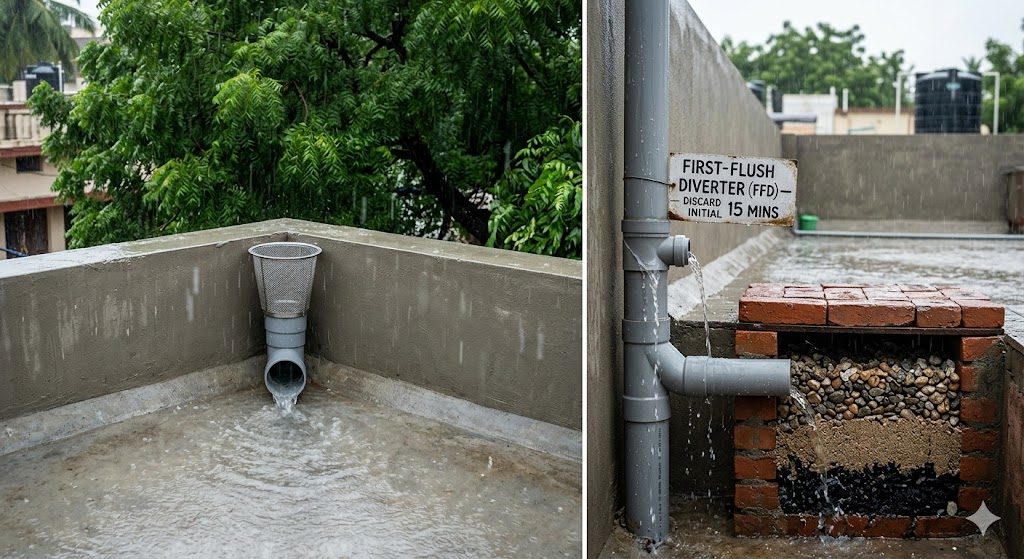
This article is a systems-oriented guide to reducing household energy use through off-grid water design, and it is most valuable for readers interested in combining rainwater harvesting with low-energy plumbing strategies. Its central idea is that water and energy should be designed together rather than treated as separate utility problems. The article highlights a chain that moves from roof capture to storage, then to gravity-fed use where possible, with low-pressure distribution and solar-timed pumping used only when necessary. That combination reduces dependence on electric pumping and can make a household system more resilient during outages.
A key practical contribution is the emphasis on matching the delivery method to the topography and usage pattern. Gravity-fed distribution is inherently lower-energy than pump-driven systems, so the article’s approach is to place storage and fixtures in ways that minimize lift requirements and pressure losses. It also discusses solar-timed pumping, which suggests using pumping when solar power is available rather than relying on grid electricity or batteries for all transfers. This matters for off-grid or semi-off-grid homes because pump scheduling can be one of the simplest ways to reduce operating costs without changing the water source itself.
The article also integrates greywater reuse with low-flow fixtures, which is important because water efficiency is not just about harvesting more rain; it is also about lowering demand and keeping water in circulation longer before discharge. Greywater reuse can extend the utility of harvested rainwater by reducing the volume needed for non-potable tasks, while low-flow fixtures lower total daily consumption. For practitioners, the article’s value is in the systems thinking: capture, store, move, use, reuse, and only then discharge. It is best read as a design framework for households trying to minimize energy use while maintaining reliable water service, especially where electricity supply is costly, intermittent, or deliberately avoided.
Source: studiomatrx.org
Related Analysis
- Regenwasser nutzen: 5 Wege, was sie wirklich kosten – und die Rechtslage, die viele übersehen — Regenwassernutzung ist in Deutschland Mainstream – von der Regentonne bis zur Erd-Zisterne. Wir zeigen fünf Wege vom Gar…
- Water-Harvesting Swales: What They Cost, Where Practitioners Agree — and the One Real Safety Debate — Swales — level, on-contour ditches that slow, spread and sink rainwater into the soil — are a foundational permaculture …
Related on PermaNews
- Finnish Off-Grid: Rocket Mass Heater Performance in Greenhouse (Case Study)
- Berlins schwimmende Gärten: Permakultur auf dem Wasser (Case Study)
- Rodale Report 2025: Thermal Mass Boost in Solar Greenhouses (Case Study)
- Finca Bellavista: Costa Rica's 200-Acre Water System Innovation (Case Study)
- Priya's 2024 India Report: 10-Hectare Water Harvesting Success (Case Study)
- Earthaven Ecovillage: 30 Years Off-Grid with Hydro & Solar (Video)
Explore more in Water, Climate & Adaptation — the full hub for this knowledge area.