Land Project Legal Entities: Soul Fire Farm's 3D Virtual Guide
By Soul Fire Farm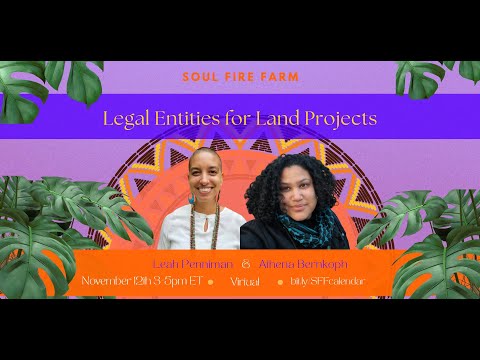
PermaNews Brief
Key Takeaways
Selecting the right legal entity for your land project is crucial for its success, impacting liability, taxes, and funding opportunities.
- Choose legal structure early in project development.
- For-profit options include sole proprietorships, partnerships.
- Non-profits offer tax exemption for public benefit.
- Corporations provide liability protection for owners.
- Understand implications for liability, tax, governance.
- Careful planning supports long-term land stewardship.
Why It Matters
The legal framework of a land project directly influences its operational stability, financial viability, and ability to achieve its mission, whether it's focused on permaculture, community, or ecological stewardship.
What to Do Next
Review the different legal entity types outlines in this summary and consider which best aligns with your project’s goals and structure.
Recommended for: Anyone initiating or involved in the long-term planning and establishment of land-based permaculture, community, or ecological stewardship projects.
The Soul Fire Farm article on "Legal Entities for Land Projects" provides a detailed overview of various legal structures available to groups or individuals engaged in land-based initiatives, particularly those with a focus on permaculture, community, or ecological stewardship. The discussion emphasizes the importance of selecting an appropriate legal entity early in a project's development, as this choice significantly impacts liability, taxation, governance, and the ability to raise capital or receive grants.
The article begins by broadly categorizing legal entities into two main types: for-profit and non-profit. For-profit entities are typically designed to generate income for their owners or shareholders, while non-profit entities are established for public benefit and are generally exempt from certain taxes. However, the article highlights that the distinction isn't always rigid, as some for-profit structures can incorporate social or environmental missions, and non-profits often engage in revenue-generating activities to support their mission.
Among the for-profit options, the sole proprietorship is presented as the simplest structure, suitable for individuals operating a land project independently. It offers ease of formation and minimal regulatory burden, but the owner bears unlimited personal liability for all business debts and obligations. Partnerships, including general partnerships and limited partnerships, are discussed as structures for two or more individuals. General partnerships also entail unlimited personal liability for all partners, while limited partnerships allow for some partners to have limited liability, provided they do not actively manage the business. The article notes that clear partnership agreements are crucial to define roles, responsibilities, and profit-sharing arrangements.
Corporations (C-Corps and S-Corps) are introduced as more complex structures that provide liability protection to their owners (shareholders). C-Corps are subject to "double taxation" (corporate profits are taxed, and then dividends to shareholders are taxed again), but they offer flexibility in ownership and fundraising. S-Corps avoid double taxation by passing profits and losses directly to shareholders' personal income, but they have restrictions on the number and type of shareholders. The article suggests that corporations might be suitable for larger land projects seeking significant investment or with a desire for formal governance structures.
Limited Liability Companies (LLCs) are presented as a popular hybrid option, combining the liability protection of a corporation with the pass-through taxation of a partnership or sole proprietorship. LLCs offer flexibility in management and ownership, making them attractive for many land-based ventures. The article also touches upon B Corporations (Benefit Corporations), which are a type of for-profit entity legally committed to creating a positive impact on society and the environment, alongside generating profit. This structure is particularly relevant for permaculture projects aiming for both financial viability and ecological regeneration.
For non-profit endeavors, the article focuses on 501(c)(3) organizations, which are tax-exempt under federal law and can receive tax-deductible donations. Establishing a 501(c)(3) involves a rigorous application process with the IRS and requires adherence to strict governance rules, including a board of directors and a clear public benefit mission. The article mentions that non-profits are often ideal for land projects focused on education, conservation, or community development, and can access grants and philanthropic funding.
Beyond these traditional structures, the article explores less common but increasingly relevant options for land projects. Cooperatives are highlighted as member-owned and democratically controlled organizations, where members share in the benefits and responsibilities. This model aligns well with permaculture principles of community and shared resources. Land trusts are also discussed as non-profit organizations that acquire and hold land or conservation easements to protect natural resources, agricultural land, or historic properties. They are crucial for ensuring long-term land stewardship and preventing development.
The article also briefly touches upon fiscal sponsorship, an arrangement where a smaller, unestablished project operates under the legal and tax-exempt status of an existing non-profit. This can be a valuable pathway for new land projects to access grants
Source: youtube.com
Related Analysis
- Private Capital Breaks From ESG to Target Farm System Overhaul — Initial signals suggest large-scale capital is being positioned toward agricultural transformation, with a $1.4B Midwest…
- IUCN Guidelines Shift Rewilding From Concept to Formal Practice — The IUCN's newly released Global Guidelines for Rewilding offer the field's first authoritative framework, arriving as p…
Explore more in Community, Policy & Systems Change — the full hub for this knowledge area.