Super High Tech Off-Grid Tiny House for Sustainable Living
By Exploring Alternatives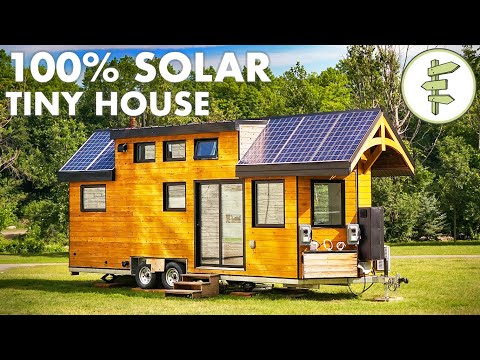
PermaNews Brief
Key Takeaways
This video explores a state-of-the-art off-grid tiny house focused on sustainability and self-sufficiency.
- Net-zero, 100% solar-powered design
- Innovative atmospheric water generation
- Compact systems for energy autonomy
- Addresses alternative water sourcing solutions
- Visual case study for micro-housing design
Why It Matters
This project exemplifies how tiny homes can integrate multiple sustainable technologies, making them ideal for resilient living. It addresses the growing need for energy and water independence, particularly in uncertain climates.
What to Do Next
Watch the video for insights into off-grid living solutions.
Permaculture Context
What makes this project genuinely instructive for permaculture practitioners is not the novelty of solar power or even the atmospheric water generator in isolation — it is the demonstration that a very small built structure can serve as a functional systems integration platform rather than simply a shelter. Most discussions of off-grid living treat energy, water, and food as separate design domains, but compact dwellings force a discipline that larger homesteads often avoid: every system must justify its footprint and interact efficiently with the others. For anyone designing a resilience hub, a guest cabin, or a transitional dwelling on a regenerative property, this build offers a concrete spatial reference for how power generation and water independence can be embedded into the building envelope itself rather than bolted on as afterthoughts. The atmospheric water generation component is particularly worth tracking because it addresses the single most common vulnerability in off-grid water planning — the assumption that precipitation or a reliable water table will always be available. As climate patterns grow less predictable, designs that layer multiple independent water sources into a small package become not experimental curiosities but legitimate planning baselines.
Recommended for: Anyone interested in innovative solutions for sustainable living.
This video tours a highly technical off-grid tiny house designed for sustainable living, making it directly relevant to resilient housing systems and compact self-sufficient dwellings. The description identifies the home as a net-zero tiny house that is 100% solar powered, with a roof made of integrated solar panels. That alone makes it useful for anyone researching energy-positive or energy-autonomous small homes, but the project goes further by including an atmospheric water generator prototype. That feature is especially significant for tiny-house and resilience planning because it points to alternative water sourcing beyond wells, municipal supply, or rainwater catchment. The combination of integrated solar generation and experimental water production shows a design approach focused on reducing dependence on conventional utility networks. Because the video is framed as a full tour, it likely provides spatial and systems-level context, which is valuable for practitioners trying to understand how these technologies are physically integrated into a very small footprint. The most actionable value here is not generic advocacy for sustainability, but a visible example of how a tiny house can function as a platform for multiple off-grid technologies at once. For audiences interested in permaculture, emergency preparedness, or regenerative housing, the project offers a concrete reference point for pairing compact shelter with renewable power and innovative water resilience. It is also relevant as a design case for high-performance micro-housing, where the challenge is not only reducing size and consumption but also maintaining comfort, habitability, and independence in a constrained envelope. The source is most useful as a visual and conceptual case study rather than a step-by-step how-to guide.
Source: youtube.com
Related Analysis
- Off-Grid Homesteads Merge Thermal and Electrical Renewable Systems — Several 2024–2025 case studies show off-grid permaculture sites pairing rocket mass heaters with solar or micro-hydro el…
- Off-Grid Solar Projects Shed Legacy Batteries for LFP — Several sources suggest LFP batteries are becoming the go-to storage solution as solar adoption grows across off-grid an…
Explore more in Shelter, Energy & Infrastructure — the full hub for this knowledge area.