Geoff Lawton: Local Food vs. Industrial Ag Efficiency
By Discover Permaculture with Geoff Lawton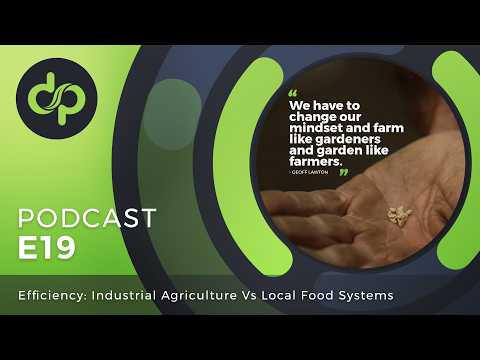
TL;DR: Local food systems, rooted in permaculture, offer superior resilience and resource optimization compared to industrial agriculture, which prioritizes volume over sustainability.
- Industrial agriculture conceals hidden costs despite large-scale production.
- Monocultures and external inputs create fragile, resource-intensive systems.
- Long supply chains increase carbon emissions and food waste.
- Local permaculture systems optimize resources and enhance ecological health.
- Diversity in permaculture reduces reliance on external inputs.
- Reduced transport in local systems lowers carbon footprint, improves freshness.
- Direct producer-consumer links foster sustainable practices.
Why it matters: Understanding the true efficiency of food systems is crucial for building resilient, environmentally sound agricultural practices and ensuring food security.
Do this next: Explore local farms or community gardens in your area to learn about their practices.
Recommended for: Anyone interested in permaculture, sustainable agriculture, or the environmental and social impacts of food production.
The discussion explores the contrasting efficiencies of industrial agriculture and local food systems, particularly through the lens of permaculture principles. Industrial agriculture, while appearing efficient in terms of large-scale production and distribution, often overlooks significant hidden costs and inefficiencies. Its focus on monoculture and reliance on external inputs like synthetic fertilizers, pesticides, and fossil fuels creates a system that is inherently fragile and resource-intensive. The long supply chains involved in transporting food across vast distances contribute substantially to carbon emissions and food waste, as produce often needs to be harvested prematurely or treated to withstand long journeys. This model prioritizes quantity and uniformity over nutritional quality and ecological health.
Conversely, local food systems, especially those incorporating permaculture design, demonstrate a different kind of efficiency. While they may not produce the same sheer volume of a single crop as industrial farms, their efficiency lies in their resilience, resource optimization, and ecological benefits. Permaculture emphasizes diversity, integrating various plant and animal species to create synergistic relationships that reduce the need for external inputs. For instance, companion planting can deter pests, while cover crops can enrich soil fertility, minimizing the reliance on synthetic chemicals.
A key aspect of local food systems is the drastically reduced transportation distance. Food grown and consumed within a community significantly lowers fuel consumption and carbon footprints. This proximity also allows for harvesting at peak ripeness, leading to higher nutritional content and better flavor, and substantially reduces post-harvest losses due to spoilage during transit. The direct connection between producers and consumers fosters a greater understanding of food origins and encourages sustainable practices.
Furthermore, local food systems often prioritize soil health, viewing it as the foundation of a productive ecosystem. Practices like composting, mulching, and no-till farming enhance soil structure, water retention, and microbial life, leading to healthier plants and a reduced need for irrigation and chemical amendments. This long-term investment in soil fertility contrasts sharply with industrial agriculture's often extractive practices that can degrade soil over time.
The concept of "efficiency" itself is re-evaluated. Industrial agriculture's efficiency is often measured by output per acre or labor hour, without fully accounting for environmental degradation, resource depletion, and the social costs associated with its model. Local food systems, on the other hand, define efficiency more broadly, encompassing ecological health, community resilience, nutritional density, and reduced waste. They aim for a closed-loop system where waste products are repurposed, and resources are cycled effectively within the farm or community.
The discussion highlights that while industrial agriculture has been successful in feeding a large global population, its long-term sustainability is questionable due to its reliance on finite resources and its negative environmental impacts. Local food systems, particularly those guided by permaculture principles, offer a more sustainable and resilient alternative by focusing on ecological integration, resource conservation, and community well-being. They represent a shift from a linear, extractive model to a circular, regenerative one, ultimately offering a more holistic and enduring form of efficiency.
Source: youtube.com
Related Analysis
- Farms Build Resilience, Pivot to Regenerative Soil — New initiatives and analysis explicitly frame regenerative agriculture as a direct solution for climate resilience, focu…
- Federal Policy Pivots, Builds Indigenous Agriculture Frameworks — Federal policy trends are integrating Indigenous knowledge with soil science in regenerative agriculture, shifting polic…
Related on PermaNews
- PRI Australia's 10-Year Temperate Food Forest Guild Results (Case Study)
- Permaculture is not theory. It’s relationships (Video)
- Geoff Lawton: Permaculture Solutions for Wildfire Resilience (Video)
- Geoff Lawton: 20 Years of Permaculture Evolution Unveiled (Video)
- Greening the Desert: Lawton's Permaculture Blueprint (Video)
- Homesteading Myths: 10 Costly Errors (Ep. 389) (Video)
Explore more in Food Systems & Growing — the full hub for this knowledge area.