Unlocking Sustainable Farming: The Soil Health Cycle's Future
By Not specified (references researchers like Maharjan and colleagues)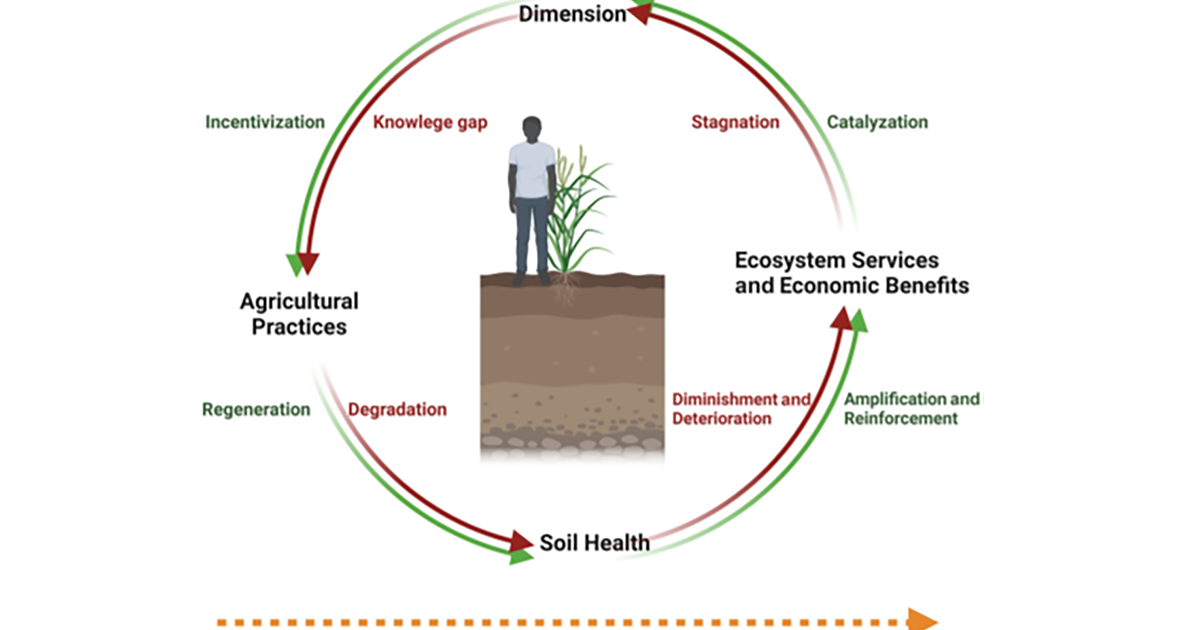
TL;DR: Holistic soil health practices are key to building resilient, profitable, and environmentally sound farming systems.
- Integrate practices for improved soil organic matter and microbial activity.
- Enhance water infiltration and nutrient retention for better yields.
- Reduce input costs and environmental impacts.
- Monitor progress with simple soil tests.
- Transition requires education, incentives, and policy support.
- Healthy soil creates feedback loops for sustained benefits.
Why it matters: Adopting a soil health cycle approach can transform agriculture, providing a roadmap for farmers to achieve environmental stewardship and economic viability simultaneously, leading to more resilient global food systems.
Do this next: Assess your current soil health using simple tests like respiration or aggregate stability to identify areas for improvement.
Recommended for: Farmers and agricultural professionals seeking a comprehensive strategy for sustainable and profitable farming.
The soil health cycle framework represents a holistic approach to sustainable agriculture, integrating key management practices with measurable soil indicators and ecosystem services for resilient, profitable farming systems. Developed by researchers including Maharjan and colleagues, it illustrates how practices like no-till farming, cover cropping, diverse crop rotations, and livestock integration drive improvements in soil organic matter, microbial activity, water infiltration, and nutrient retention. These changes, in turn, enhance crop yields, reduce input costs, and mitigate environmental impacts such as erosion and greenhouse gas emissions. The cycle begins with farmer-adopted practices that alter soil physical, chemical, and biological properties, leading to better ecosystem outcomes like biodiversity and carbon sequestration. Feedback loops reinforce benefits, as healthier soils support more effective practices over time. The January 2026 CSA News article emphasizes its application in real-world scenarios, from row crops to pastures, highlighting profitability through lower fertilizer needs and higher resilience to droughts or floods. Case studies show no-till with covers increasing soil organic carbon by 0.5-1% annually, while rotations diversifying microbes suppress pathogens naturally. Livestock grazing managed cover crops recycles nutrients efficiently, closing the cycle. Challenges include initial transition costs and knowledge gaps, addressed via education and incentives. The framework aligns with global sustainability goals, positioning U.S. agriculture as a leader. Researchers stress monitoring via simple tests like soil respiration or aggregate stability to track progress. Future directions involve scaling through policy support and technology, like precision tools for practice optimization. Overall, the soil health cycle offers a roadmap for farmers to achieve environmental stewardship without sacrificing economics, fostering a regenerative paradigm shift essential for feeding a growing population amid climate change.