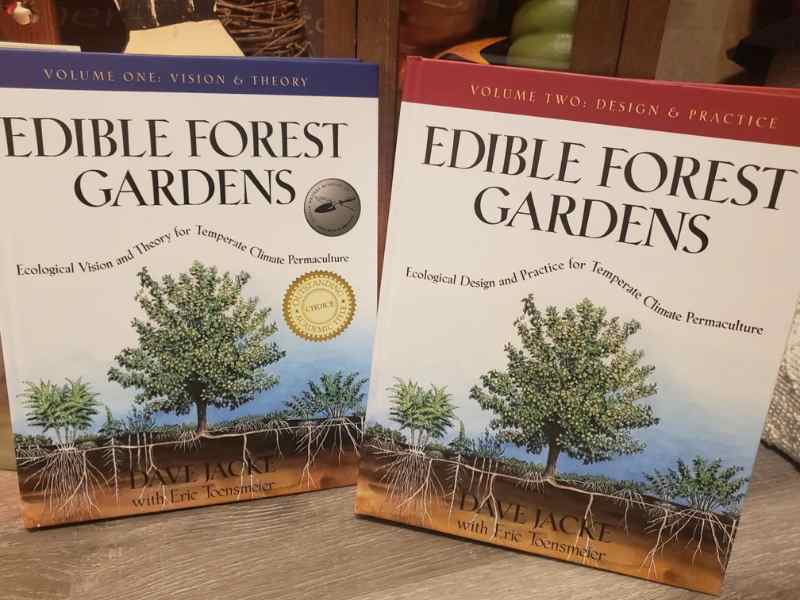
Dave Jacke & Eric Toensmeier: Edible Forest Gardens Guide
PermaNews Brief
Key Takeaways
Design and implement resilient, edible ecosystems by mimicking natural forest patterns with permaculture principles and diverse perennial plants.
- Mimic natural forest structures for abundant perennial food systems.
- Utilize permaculture principles: sector analysis, zoning, plant guilds.
- Design across seven layers: canopy down to fungal networks.
- Select plants based on climate, soil, and functional roles.
- Emphasize observation, low-input methods, and pathways.
Why It Matters
Implementing forest gardens offers a regenerative approach to food production, increasing biodiversity and long-term food security while minimizing external inputs and fostering ecological resilience.
What to Do Next
Begin a site assessment to understand your microclimate, soil, and existing conditions before selecting any plants.
Permaculture Context
For anyone serious about moving beyond the annual vegetable garden treadmill, Jacke and Toensmeier's work represents something rare: a genuinely transferable design framework rather than another collection of gardening tips. What makes this particularly significant for regenerative practitioners is the shift in mental model it demands — from managing plants to stewarding relationships. The guild-based approach changes how you read a landscape entirely, training you to see deficiencies and opportunities in terms of ecological function rather than individual species. Practically speaking, this means a smallholder in zone 6 can stop purchasing fertility inputs year after year and instead engineer it into the system through intelligent plant selection from the outset. The layered canopy framework also dramatically increases caloric and medicinal yield per square foot without proportional labor increases — a critical consideration for anyone designing toward genuine self-reliance rather than supplemental production. Where most permaculture resources stay inspirational, this two-volume set gives practitioners the technical depth to make consequential, site-specific decisions with lasting impact on household food security and land health.
Recommended for: Dedicated permaculture designers, serious ecological gardeners, and those planning large-scale regenerative food systems.
Edible Forest Gardens, a seminal two-volume set by Dave Jacke and Eric Toensmeier, offers a comprehensive blueprint for designing, implementing, and managing temperate-zone perennial polycultures that mimic natural forests while producing abundant human food. Volume 1 focuses on ecological vision and theory, detailing design principles like sector analysis (mapping energies like wind, fire, wildlife), zoning for efficiency, and guild creation where plants mutually support each other—nitrogen-fixers aiding heavy feeders, dynamic accumulators mining deep nutrients. It introduces the forest garden layers: canopy trees, low trees, shrubs, herbaceous, groundcover, vining, root, and fungal, with real-world examples from North America. Volume 2 shifts to practical implementation, providing 500+ plant profiles with cultivation details, yields, functions (e.g., pest control, pollination), and site requirements. The authors emphasize observation-based design, starting with site assessment to match species to microclimates, soils, and goals—food, medicine, crafts. Case studies illustrate successes and pitfalls, like overplanting invasives or ignoring paths, underscoring accessibility's role. Pathways, though not the sole focus, are integral for harvest, maintenance, and evolution, often organic-shaped to blend with contours. The books advocate low-input systems post-establishment, using chop-and-drop mulches and natural succession. Permaculture roots shine through ethics of earth care, people care, fair share, integrated with ecology. Over 700 illustrations, charts, and appendices (plant matrices, resources) make it accessible yet rigorous. Published around 2005, it remains foundational, influencing global food forest movements. Redemption Permaculture's review praises its detail for serious designers, bridging theory-practice gap. For planning, use templates for sun maps, yield projections; for maintenance, sector-driven pruning and succession planting. Complements modern hacks like David's mowing paths by providing species depth. Challenges addressed: deer pressure (thorny barriers), soil building (sheet mulching), scaling (micro to acres). Yields potential: nuts, fruits, berries, greens rival annual farms long-term. Authors' Vermont projects exemplify resilience, diverse outputs buffering failures. Educational value high for workshops, with exercises fostering designer mindset. Critiques note temperate bias (adapt for tropics), density overwhelming novices—but volumes guide phased rollout. Integrates economics: value-added products like syrups, medicinals. Biodiversity boosts ecosystem services: carbon sequestration, water purification, habitat. Future-oriented, addressing climate via resilient perennials. Essential for regenerative agriculture, inspiring projects worldwide. Paired with field trials, it empowers self-reliant food systems.
Source: redemptionpermaculture.com
Related Analysis
- Composting Advice Shifts From Chemistry to Microbial Biology — Several sources suggest composting guidance is pivoting from nutrient ratios toward microbial ecology—reframing what "go…
- Does Growing Your Own Food Actually Save Money? The Real Numbers — Most home gardens save money by year two — but only if the right crops are planted. Herbs and salad greens deliver 5–10x…
Related on PermaNews
- Ernst Götsch's Cacao Syntropy: Master Agroforestry Now (How-To Guide)
- Finnish Off-Grid: Rocket Mass Heater Performance in Greenhouse (Case Study)
- Berlins schwimmende Gärten: Permakultur auf dem Wasser (Case Study)
- Rodale Report 2025: Thermal Mass Boost in Solar Greenhouses (Case Study)
- AUTarcaMatricultura La Palma: Permakultur & Energieautarkie (How-To Guide)
- Earthaven Ecovillage: 30 Years Off-Grid with Hydro & Solar (Video)
Explore more in Food Systems & Growing — the full hub for this knowledge area.