Regenerative vs. Permaculture: Vogel's Key Distinctions
By Peter Vogel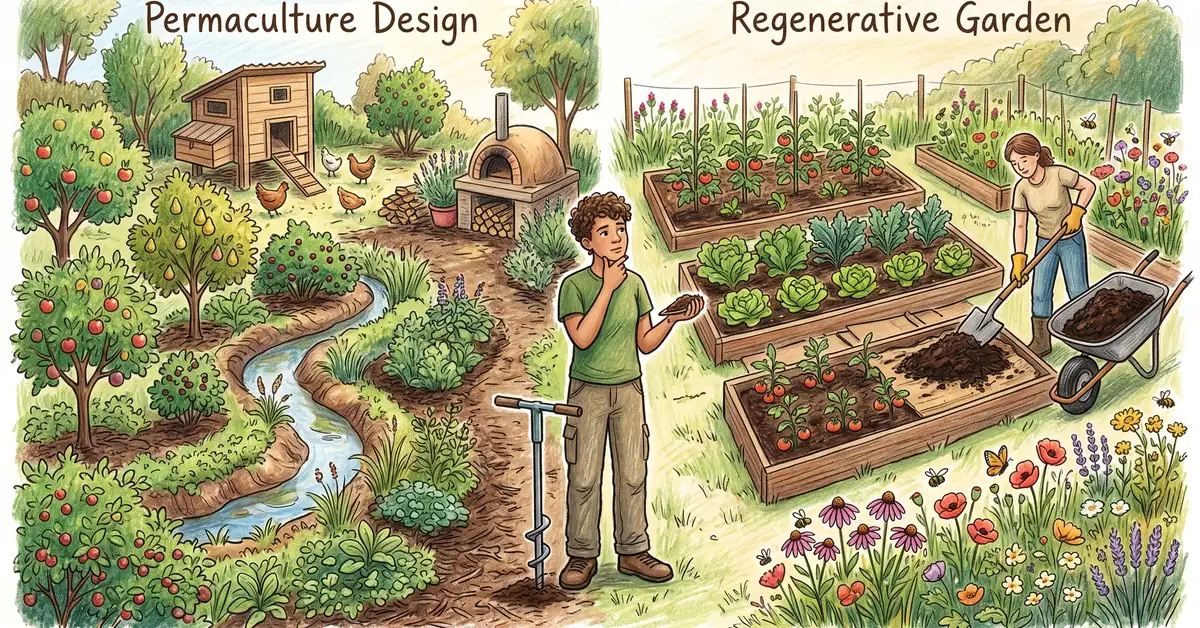
TL;DR: Regenerative gardening and permaculture both aim for sustainable land use, but regenerative focuses on rapid soil health improvement, while permaculture offers a broader, holistic design approach.
- Regenerative gardening prioritizes fast soil rebuilding and carbon sequestration.
- Permaculture is a whole-system design framework based on natural patterns.
- Both emphasize perennials, polycultures, and ecological practices.
- Regenerative measures quantifiable soil improvements like carbon levels.
- Permaculture incorporates ethics of earth care, people care, and fair share.
Why it matters: Understanding the distinctions between regenerative gardening and permaculture helps practitioners select the most effective strategies for their specific goals, whether it's rapid soil improvement for a community garden or a long-term, integrated homestead design.
Do this next: Conduct a soil health test for your garden to establish a baseline before implementing new practices.
Recommended for: Gardeners, farmers, and land stewards seeking clarity on regenerative agriculture and permaculture to inform their practice.
Written by Peter Vogel, founder of GrowPerma, this practitioner analysis compares evidence-based regenerative gardening with whole-system permaculture, offering signal-rich distinctions for self-sufficiency projects including community applications. Regenerative gardening centers on soil rebuilding through practices like minimal tillage, diverse cover crops, and living roots year-round to enhance soil organic matter, microbial diversity, and carbon sequestration, directly addressing climate change by drawing down atmospheric CO2 into stable soil humus. Key methods include no-till planting, inoculating with mycorrhizal fungi, and using biofertilizers from compost teas to boost biology without chemicals. Permaculture, in contrast, is a holistic design framework integrating agriculture, architecture, and social systems based on observing natural patterns—zoning high-use areas near homes, swales for water harvesting, food forests with stacked canopy layers, and guilds of companion plants for mutual benefits. The article delineates overlaps, such as both emphasizing perennials and polycultures, but highlights regenerative gardening's sharper focus on quantifiable soil metrics (e.g., Haney soil health tests showing active carbon increases) versus permaculture's broader ethics of earth care, people care, and fair share. For community contexts, it advises regenerative techniques for quick soil turnaround in shared plots—e.g., inoculating raised beds with compost extracts—while permaculture suits long-term site designs like edible landscapes with chickens for pest control and fertility. Practical insights include starting with soil tests to baseline health, then applying regenerative protocols like tarping for weed suppression followed by direct seeding, versus permaculture's sector mapping for wind and water flows. Vogel provides case examples: a community garden using regenerative no-till beds yielding 30% more produce with half the labor, compared to a permaculture homestead integrating aquaponics and passive solar greenhouses. Actionable steps cover hybrid approaches, such as regenerative soil prep within permaculture zones, tool recommendations like broadforks for aeration, and monitoring via apps for carbon credits. This depth helps practitioners choose or blend systems for resilient, low-input community gardens that regenerate ecosystems while producing abundant food.