Self-Sufficient Food: Dehydrating Tomatoes & Herbs
By Self Sufficient Homesteading & Gardening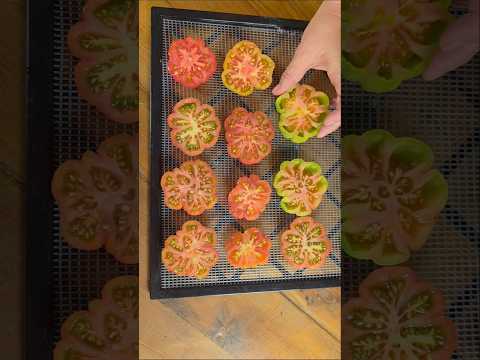
TL;DR: Dehydration extends the shelf life of seasonal produce like tomatoes and herbs, offering a practical method for food preservation.
- Dehydration preserves seasonal produce beyond the growing season.
- Proper preparation ensures even drying and prevents spoilage.
- Tomatoes need thorough washing and uniform slicing for drying.
- Dehydrators require specific temperatures and air circulation.
- Store dehydrated goods in airtight containers once cooled.
Why it matters: Extending the usability of your harvest minimizes waste and boosts food self-sufficiency for year-round enjoyment.
Do this next: Prepare your tomatoes by washing and slicing them uniformly for dehydration.
Recommended for: Anyone interested in practical food preservation, reducing food waste, and enhancing food self-sufficiency.
The article discusses the process of dehydrating tomatoes and herbs as a method of food preservation, a practice often associated with self-sufficient living and homesteading. Dehydration is presented as a valuable technique for extending the shelf life of seasonal produce, allowing individuals to enjoy their harvest long after the growing season has ended.
For tomatoes, the process typically involves several steps to ensure optimal drying and preservation. Initially, the tomatoes need to be prepared. This usually means washing them thoroughly to remove any dirt or debris. Depending on their size, tomatoes might be sliced into uniform pieces, such as halves, quarters, or even thinner slices, to facilitate even drying. Smaller varieties, like cherry tomatoes, can often be dried whole or cut in half. The core or stem end is often removed. Some methods suggest blanching tomatoes briefly before drying, which can help to loosen the skins and prevent discoloration, though this step is not always deemed essential, especially for smaller pieces.
Once prepared, the tomato pieces are arranged in a single layer on dehydrator trays. It's crucial to ensure there's adequate space between pieces for air circulation, which is vital for efficient drying. The dehydrator is then set to a specific temperature, typically in the range of 125-140°F (52-60°C). The drying time can vary significantly based on the thickness of the tomato slices, the moisture content of the tomatoes, and the dehydrator model, often ranging from several hours to a full day or even longer. The tomatoes are considered fully dehydrated when they are leathery or brittle to the touch, with no remaining moisture. They should not be soft or pliable, as any residual moisture can lead to spoilage. Once dried, they are allowed to cool completely before being stored in airtight containers in a cool, dark place.
Dehydrating herbs follows a similar principle but often requires less preparation and drying time due to their lower moisture content. Fresh herbs are first washed gently and patted dry to remove excess surface water. It's important to handle them carefully to avoid bruising. The leaves are then typically removed from the stems, especially for larger-leafed herbs. Smaller herbs can sometimes be dried on their stems.
Similar to tomatoes, the prepared herb leaves are spread in a single layer on dehydrator trays, ensuring good air circulation. The dehydrator temperature for herbs is usually set lower than for fruits and vegetables, often around 95-115°F (35-46°C), to preserve their volatile oils and flavor. Higher temperatures can cause the herbs to lose their potency and color. Drying time for herbs is generally shorter, often taking only a few hours. Herbs are considered fully dehydrated when they are brittle and crumble easily. They should not feel soft or pliable. After drying, they are cooled and then stored whole or crushed in airtight containers. Storing them whole and crushing them just before use can help retain their flavor for longer.
The article emphasizes that dehydrated tomatoes and herbs can be used in a variety of culinary applications. Dried tomatoes can be rehydrated and added to sauces, stews, soups, or used in pestos and salads. Dried herbs can be incorporated into almost any dish where fresh herbs would be used, providing flavor and aroma. This method of preservation not only reduces food waste but also allows for a year-round supply of homegrown produce, aligning with the principles of self-sufficiency and sustainable living. The process is presented as a practical and rewarding way to manage a bountiful harvest.