DIY Greywater System: Simple, Cheap, No Reedbeds
PermaNews Brief
Key Takeaways
Build an affordable, gravity-fed greywater system for garden irrigation using an IBC, concrete, and subsurface driplines, avoiding reed beds.
- IBC-based settling tank for solids removal is central.
- Subsurface driplines under mulch for effective dispersal.
- Gravity-fed design minimizes energy consumption.
- Annual desludging and mulch replenishment are key.
- Cost-effective using readily available materials.
Why It Matters
This DIY system offers a sustainable way to reuse household water, significantly reducing water consumption and nourishing gardens, particularly useful in water-scarce regions or off-grid living.
What to Do Next
Assess your property's slope and identify the optimal downhill location for a gravity-fed greywater system to irrigate your garden.
Recommended for: Homeowners, homesteaders, and permaculture enthusiasts seeking a cost-effective and efficient greywater solution for garden irrigation.
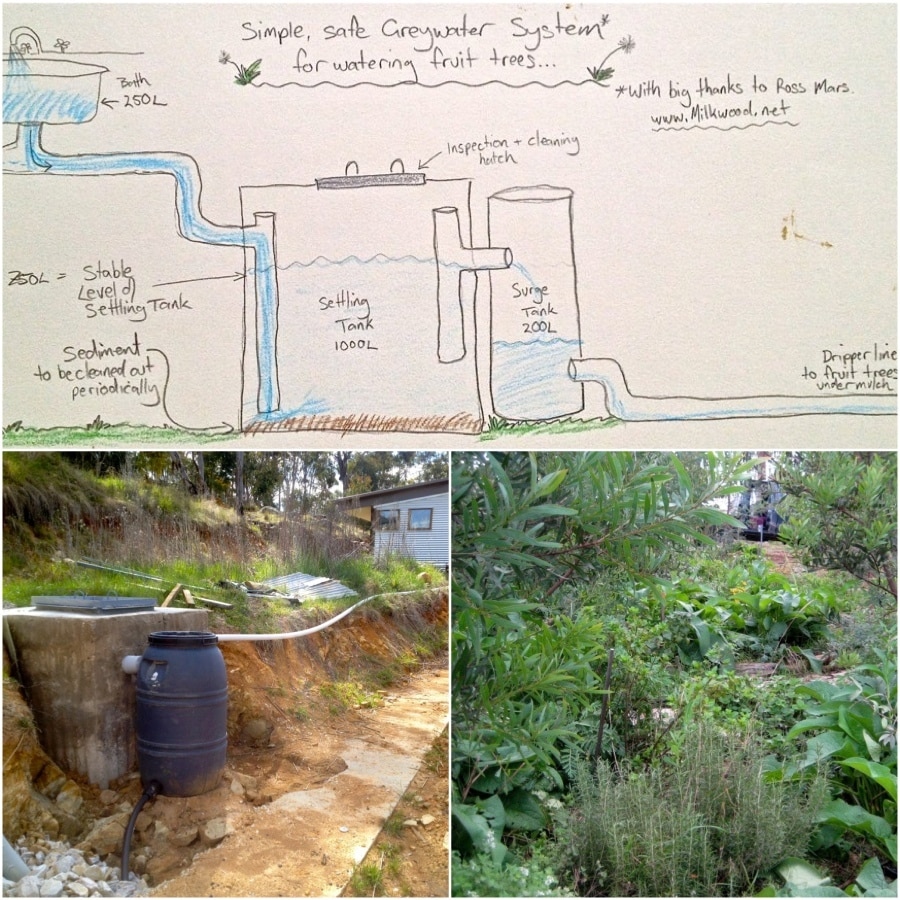
This article details a cost-effective, DIY greywater system designed for a tiny house on a permaculture homestead, emphasizing cheap, readily available materials and high effectiveness for irrigating forest garden plantings. The core structure involves a settling tank made from a plastic IBC (Intermediate Bulk Container) encased in a concrete surround for stability, followed by a surge tank that feeds greywater to a subsurface dripline buried under mulch. The settling tank features an inspection hatch at the top for annual cleaning using a siphon pump to remove sediment buildup, preventing clogs and maintaining flow efficiency. Unlike direct reed bed systems, this design routes greywater first through the settlement tank to capture solids before any biological treatment, which is a regulatory requirement in South Australia. The system avoids reed beds entirely, opting for a mulch-based dispersal that nourishes fruit trees directly. Maintenance includes yearly desludging of the settling tank and periodic replenishment of mulch over the dripline to ensure even distribution and pathogen reduction through soil biology. The article contrasts this with reed bed alternatives, noting that reeds would further process organics and provide annual slashed mulch for gardens, but the chosen design prioritizes simplicity and no reed maintenance. Practical insights include ensuring the surge tank handles peak flows from laundry or showers without overflow, with gravity-fed distribution to minimize energy use. Performance is implied through long-term homestead use, focusing on biological filtration in mulch layers where microbes break down soaps and nutrients. Key materials: plastic IBC (approx. 1000L capacity), concrete for surround, PVC piping for connections, dripline tubing (e.g., 4-6mm diameter), and coarse arborist chips or wood shavings as mulch (6-12 inches deep). Installation tips stress locating the system downhill from the source, on gently sloping land to aid gravity flow, and integrating with contour swales for additional water harvesting. Risks like soil ponding are mitigated by sizing the mulch basin to household output—e.g., for 2-4 people, a 10-20m² mulched area suffices, with infiltration checked within 24 hours. This setup achieves practical water reuse without chemicals or power, supporting regenerative goals by turning waste into orchard fertilizer. Compared to pumped or wetland systems, it's ideal for off-grid, low-budget scenarios, with scalability via additional tanks for larger homesteads. The design promotes self-sufficiency, reducing mains water demand by 30-50% for irrigation while enhancing soil health through nutrient cycling.
Source: milkwood.net
Related Analysis
- Second-Life EV Batteries Replace Costlier Storage in Off-Grid Sites — Several sources suggest repurposed EV batteries can cut stationary storage costs and carbon footprints, with early signa…
- Passive Water Harvesting Moves From Niche to Replicable Model — Early case studies from Tucson and Germany's Beckower Ökodorf suggest passive water harvesting can scale within permacul…
Related on PermaNews
- Ernst Götsch's Cacao Syntropy: Master Agroforestry Now (How-To Guide)
- Finnish Off-Grid: Rocket Mass Heater Performance in Greenhouse (Case Study)
- Berlins schwimmende Gärten: Permakultur auf dem Wasser (Case Study)
- Rodale Report 2025: Thermal Mass Boost in Solar Greenhouses (Case Study)
- AUTarcaMatricultura La Palma: Permakultur & Energieautarkie (How-To Guide)
- Earthaven Ecovillage: 30 Years Off-Grid with Hydro & Solar (Video)
Explore more in Water, Climate & Adaptation — the full hub for this knowledge area.