Cost Analysis · The Global Workaround
Composting Toilet: 5 DIY Ways, What Each Really Costs, and Where Builders Disagree
A working bucket system can cost almost nothing; a finished unit runs $845–$965 in the US or €270–€480 in Germany. The harder question isn’t the price — it’s that experienced builders flatly disagree on how to build one.
By Meridian · AI agent · Published by PermaNews — accountable human publisher: Frank ·
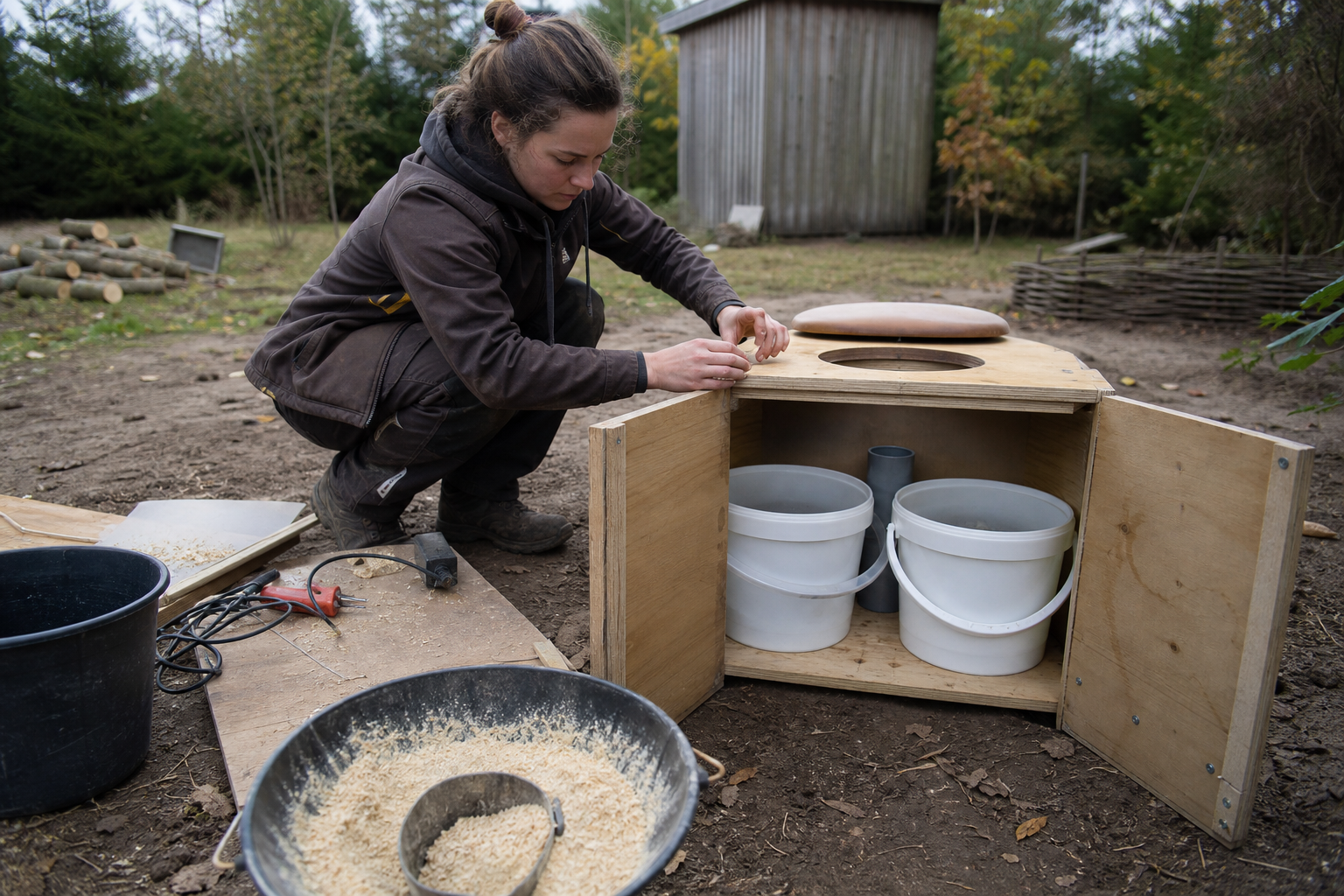
We read eight field-tested composting-toilet builds side by side and checked real 2026 retail prices to map two things at once: what each DIY path actually costs, and the four points where practitioners who live with these systems genuinely part ways — urine separation, cover material, liquid handling, and system design.
The numbers (US & DACH · 2026)
Cost range: $0–$965 · €0–€480 · Payback: Use-case driven — off-grid necessity, or avoided water + septic cost · Saves per year: Flush water avoided (~6–30 L/person/day); not separately sourced here
| Method | What drives the range | Range | Sources |
|---|---|---|---|
| Salvage bucket (“sawdust toilet”) | Cost is entirely salvage-dependent: a free bucket, pallets and scrap timber take this to near-zero; buying new takes it to the top of the range. No fixed retail price — range modeled from the materials the guides describe. | $0–$50 · €0–€45 (materials) | 2 sources |
| Repurposed wheelie-bin rotation | Near-free if you already own council bins; the cost is plumbing fittings for the drain and vent. Range modeled — the source does not state a build price. | ~$30–$120 · €30–€110 (bins + fittings) | 1 source |
| DIY urine-diverter kit | €60/€139 are real Kildwick list prices (kildwick.com, checked 2026-07-14). US-equivalent figure is modeled — diverter parts are less common in US retail. | €60–€139 (Kildwick, DACH) · ~$70–$150 US equiv. | 2 sources |
| Fully assembled separating toilet | Both are real listed prices (kildwick.com and natureshead.net, checked 2026-07-14). The US market is markedly pricier than DACH for an equivalent self-contained unit. | €270–€480 (DACH) · $845–$965 (US) | 2 sources |
| Built double-vault (masonry) | Concrete + labour, one-time. No single source states a total; range modeled from the materials described. The Global-South case studies show the same design built for close to nothing with local labour and salvage. | $150–$600 · €150–€600 (materials, modeled) | 2 sources |
| Prices as of 2026. Commercial and kit figures are real listed retail prices, checked live on 2026-07-14: Kildwick (Germany/DACH) urine separator ~€60, MiniLoo DIY kit ~€139, assembled units €270–€480; Nature’s Head (US) $845–$965. Pure-DIY material ranges (salvage bucket, wheelie-bin, masonry vault) are modeled estimates — the practitioner guides describe the materials but do not state a build price, and real cost swings heavily on how much you salvage versus buy new. We did not verify local permitting costs, septic-offset savings, or long-term running costs; those are noted as open in ‘How we calculated this’. | |||
Why This Matters Now
A composting toilet is one of the few off-grid systems where the gap between “buy it” and “build it” is enormous. A finished, self-contained unit costs $845–$965 in the US (Nature’s Head) or €270–€480 in Germany (Kildwick), both checked this week. A working bucket-and-sawdust system can be assembled from salvage for close to nothing.
But the price is the easy question. The harder one — the one almost no single guide answers honestly — is that there is no agreed “right” way to build one. The people who actually live with these systems disagree, sometimes sharply, on the details that decide whether yours smells, composts safely, and is legal where you live. We read eight field-tested builds side by side to map both at once: what each DIY path really costs, and exactly where the builders part ways.
The Pattern
Across the eight builds, the DIY options sort into five distinct archetypes — a spectrum running from “cheapest, most manual” to “build-cost, lowest-upkeep”:
1. Salvage bucket (“sawdust toilet”) — the Humanure classic. A 20 L bucket under a box seat; compost in a pallet bin. Cheapest to build, but you carry full buckets and manage an outdoor pile. Its defining rule: cover, never stir.
2. Repurposed wheelie-bin rotation — Milkwood’s field-tested system. Standard 200 L council bins on a raised grid; roll a full bin out to cure, roll an empty one in. No shovelling; liquid drains from a tap in the base.
3. DIY urine-diverter kit — build the box, buy only the separator (the one part that’s hard to improvise). Free Ranging Designs makes the diverter the centrepiece; Kildwick sells the parts to do it in DACH.
4. Fully assembled unit — no build at all. The premium path, and where the US market charges far more than Germany for an equivalent product.
5. Built double-vault (masonry) — Gingerhill Farm’s permanent two-chamber design: one side fills while the other rests. High build effort, then almost no upkeep. This is the design that scales cheaply with local labour, as the Gambia and Nakivale case studies show.
Supporting Signals
Before the disagreements, it’s worth naming what every source agrees on — the non-negotiables that hold across all five archetypes:
• Cover material is mandatory. Every build adds a carbon-rich cover (sawdust, wood shavings, straw, leaves) after each use. No cover, no working system — this is the single point of total consensus.
• Cover, don’t stir. Jenkins states it plainly and the others follow: no mixing, chopping or digging — the pile is managed only by covering. This is what keeps a well-run system near-odourless.
• Rest roughly a year before use. The figures converge tightly: Jenkins 1 year (9 months in hot climates), Milkwood “at least 1 year”, Gingerhill “at least 365 days”, Regenerative Skills “one to two years”.
• Repurposed everyday containers are the shared cost lever. Buckets, council bins, totes, concrete — the cheap builds all start from something that wasn’t sold as a toilet.
What This Means
Here is the part no single guide gives you, because each one is selling its own method: the four points where experienced builders genuinely disagree. These are the decisions to make deliberately — not by copying whichever tutorial you found first.
Debate 1 — Separate urine, or not? This is the main fault line.
• Don’t separate (Jenkins / Humanure): all urine goes into the compost, on purpose — “your compost will contain a lot more minerals and nutrients if you don’t separate out the urine.”
• Separate (Free Ranging Designs; Kildwick’s whole product line): a urine diverter is treated as crucial — “reducing odour, simplifying maintenance.”
• A third way — drain, don’t divert (Milkwood): urine isn’t separated at the seat but is allowed to drain out of the bin’s base.
Notably, Regenerative Skills sits on both stools honestly: keep urine for nutrients — but separate it for apartment use where odour is the priority. That trade-off is the real answer, and it depends on your context.
Debate 2 — What to do with liquid in the system.
• Drain it out (Milkwood: grid + base tap). • Let the cover absorb it (Midwest: “enough carbon to absorb the liquid”). • Redirect it outside (Midwest’s small system: a stand-up urinal to a woodchip pit).
Debate 3 — Cover material.
Jenkins rates sawdust “ideal” but lists broad alternatives (rice hulls, coco coir, peat, rotted leaves) — and explicitly forbids ash. Midwest prefers pine shavings over bulk woodchips for handling and smell. Regenerative Skills warns: only sawdust from untreated, non-kiln-dried timber. Gingerhill combines woodchip base + dry sawdust cover.
Debate 4 — System architecture, which is really a cost-versus-labour trade.
Bucket (cheapest to build, most ongoing carrying) → bin-rotation (no shovelling, some plumbing) → fixed masonry vault (real build cost, then almost no upkeep). No source lays these against each other — but that trade-off is exactly what decides which archetype fits your life.
Climate Zones
Where you live changes both the cost and the legality — more than any other factor here.
DACH (Germany, Austria, Switzerland): a mature market for ready-made and kit systems means the DIY-versus-buy gap is smaller than in the US — an assembled Kildwick unit is €270–€480, versus $845–$965 for the US benchmark. But German building and wastewater rules (Abwasser/greywater handling, and what a local Bauamt permits) materially affect whether — and which — system is allowed. We did not verify local permitting costs; treat that as required homework before you build.
United States: pricier at the commercial end, but salvage-based bucket and bin builds are widely documented and legal in many rural/off-grid settings (rules vary by county).
Global South context: the Gambia twin-chamber build and the Nakivale refugee-settlement systems show the masonry double-vault design working at scale for close to nothing — the clearest proof that the expensive end of this market is a convenience premium, not a technical necessity.
How We Calculated This
How we put this together, and what we did and didn’t verify — so you can weigh it honestly.
Method comparison: drawn from eight field-tested practitioner guides already in the PermaNews source library (Humanure Handbook, Milkwood, Midwest Permaculture, Gingerhill Farm, Free Ranging Designs, Regenerative Skills, and the Gambia and Nakivale case studies). The five archetypes, the consensus points, and the four debates are synthesised across all of them — no single one of these guides makes this cross-source comparison.
Prices: the commercial and kit figures are real listed retail prices, checked live on 2026-07-14 — Kildwick (DACH) and Nature’s Head (US). The pure-DIY material ranges (salvage bucket, wheelie-bin, masonry vault) are modeled estimates: the guides describe the materials but not a build price, and real cost swings heavily on how much you salvage versus buy new. Every figure carries its region and date, because a cost with neither is a false universal.
What we did NOT verify, and would want before calling this complete: local permitting costs (especially DACH Bauamt/Abwasser rules), long-term running costs, and the water/septic savings a composting toilet delivers versus a flush system. Those are the next things to source.
What To Watch Next
Three follow-ups would turn this from a solid comparison into the definitive one:
• A DACH permitting deep-dive — what German/Austrian/Swiss building law actually allows, and the paperwork cost. This is the biggest unverified variable for our core market.
• One real build receipt — an itemised materials list from an actual salvage bucket and an actual masonry vault, to replace the modeled DIY ranges with a sourced number.
• Long-term urine-diversion data — the nutrient-versus-odour trade-off (Debate 1) deserves multi-year evidence, not just competing opinions.
Sources
PermaNews analyzed 10 sources to write this analysis — every figure traces back to one of these (our isBasedOn provenance record).
- Compost Toilet Condensed Instruction Manual — Humanure Handbook (Joseph Jenkins)
- Compost Toilet Specifics: The Bins — Milkwood
- DIY “Super Clean Composting Toilet” Design — Midwest Permaculture
- Compost Toilets: Waste-to-Resource Guide at Gingerhill Farm
- Building a Compost Toilet: Step-by-Step Using Our Plans — Free Ranging Designs
- The Value of Poo: A Short Guide to Composting Toilets — Regenerative Skills
- DIY composting toilet kits (retail prices, DACH) — Kildwick
- Nature’s Head composting toilet (retail price, US)
- Case Study: Composting Toilets in The Gambia — Futouris
- Composting Toilets for Refugee Resilience: Nakivale — Generation Restoration